Zum Hauptinhalt springen

Cardano News

Explore the stories below for curated news, stories, and inspiration from within the Cardano ecosystem.

202 Posts getaggt mit "development"

Alle Tags anzeigen

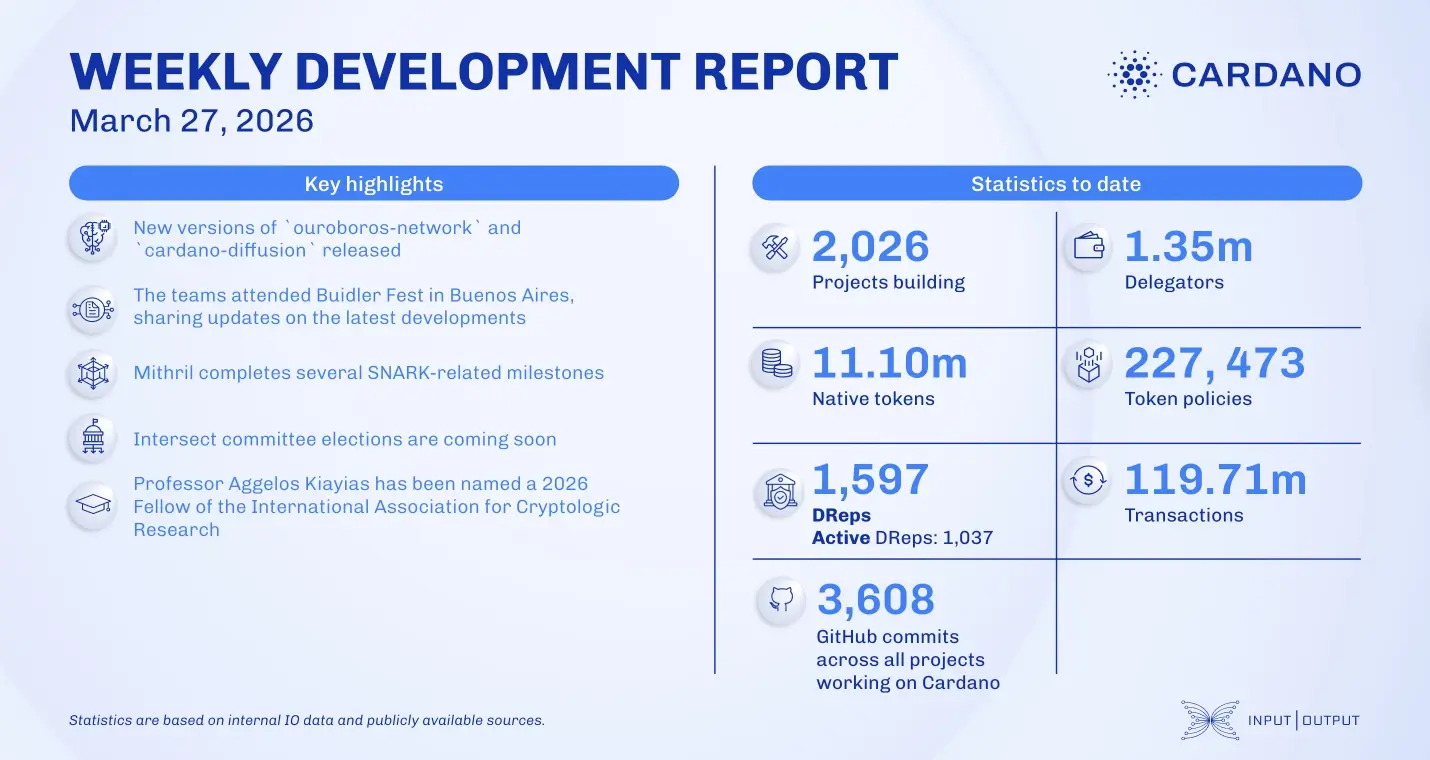
Weekly Development Report

Input Output Global
Global IO holding

The February 06, 2026, development report highlights the High Assurance team's launch of the automatic formal verification tool early access program, inviting developers to shape security tooling. In scaling news, the Mithril team released distribution 2603.1, adding support for the decentralized message queue protocol and a Blockfrost API integration. Additionally, the Input Output Research team submitted final end-of-year 2025 reports to Intersect, closing Work Package 25.

weekly development report

Yaci Store 2.0.0: The Next Evolution of Cardano Indexers

Cardano Foundation
Not-for-profit organization

The February 03, 2026, blog post by Satya Ranjan announces the release of Yaci Store 2.0.0, a high-performance Java-based indexer for the Cardano blockchain. This update introduces native ledger and governance state derivation, enabling applications to track proposals and calculate rewards directly. It also features a new plugin framework for custom data processing and operational enhancements like PostgreSQL partitioning and Prometheus monitoring, supporting scalable, production-ready deployments.

report

Weekly Development Report

Input Output Global
Global IO holding

The January 30, 2026, development report highlights the consensus team's work on Cardano node v.10.7 and the prototyping of Leios endorsement block production. The Hydra team focused on performance improvements and the Raspberry Pi demo, while the Mithril team prepared the pre-release for the 2603.1-pre distribution, introducing support for the DMQ protocol. Additionally, Intersect is facilitating an intra-era upgrade to protocol version 11.

weekly development report

Weekly Development Report

Input Output Global
Global IO holding

The January 23, 2026, development report highlights the ratification of the updated Cardano constitution, effective January 24. On the core technology front, the ledger team finalized the design for nested transactions (CIP-118) and began implementing account address enhancements (CIP-159) for the Dijkstra era. Additionally, the Mithril team focused on SNARK-friendly libraries and prepared infrastructure for the decentralized message queue (DMQ) network deployment.

weekly development report

Weekly Development Report

Input Output Global
Global IO holding

The final development report for 2025, dated December 12, highlights the approval of the Pyth Lazer oracle integration and Serviceplan Group joining Intersect as an enterprise member. The consensus team completed LSM-tree work, slated for integration in node v.10.7. Mithril made progress on its SNARK-friendly STM library and Bitcoin DeFi prover prototype. In governance, a critical vote is underway to restore the Constitutional Committee to full capacity, while Project Catalyst Fund15's community review period closes on December 15. The Midnight Redemption portal is live, and the NIGHT token is now trading on exchanges like Kraken.

weekly development report

State of the Cardano Developer Ecosystem Survey

Cardano Foundation
Not-for-profit organization

The December 11, 2025, blog post by Matthias Benkort presents the 2025 State of the Cardano Developer Ecosystem Survey results. With 109 responses, the survey highlights TypeScript, JavaScript, and Python as top proficiency languages, while over 75% of developers use Aiken for smart contracts. Key priorities include higher throughput (Leios) and improved documentation. Identity and authentication emerged as the primary focus for decentralized applications, surpassing DeFi and stablecoins.

community digest

Weekly Development Report

Input Output Global
Global IO holding

The December 5, 2025, development report highlights several key updates across the Cardano ecosystem. The ledger team finalized the Haskell definition and CDDL specification for nested transactions. Lace wallet v.1.32 was released, featuring a new notification center and allowing Midnight Foundation updates for NIGHT token holders. In scaling, the Hydra team released v.1.2.0 and implemented the 'SafeClose' feature, while Mithril advanced its SNARK-friendly STM library and aggregator discovery mechanism. Project Catalyst Fund15 moved into the community review phase with 761 proposals submitted. Additionally, Intersect hosted its 2025 Annual Members' Meeting in a virtual hub spanning 23 hours.

weekly development report

November 2025 Incident: Cardano Shows Its Resilience

Cardano Foundation
Not-for-profit organization

The December 04, 2025, blog post by CTO Giorgio Zinetti analyzes the November 21 network incident, where a malformed transaction caused a temporary chain partition. Despite the split, block production continued uninterrupted, and the network never went offline. A coordinated response from stake pool operators and ecosystem entities, along with the Ouroboros consensus mechanism, resolved the issue within 14 hours as the canonical chain prevailed, demonstrating Cardano's resilience and decentralization.

community digest

Proposed Intra-Era Hard Fork to Protocol Version 11

Intersect
Member based organization

The December 04, 2025, blog post announces a proposed intra-era hard fork to Protocol Version 11. This upgrade introduces targeted improvements to Plutus performance, ledger consistency, and node security without transitioning to a new ledger era, ensuring a lower integration burden. Key changes include enhanced Plutus primitives, VRF key uniqueness enforcement, and revised reference input rules. Intersect will convene a Hard Fork Working Group to coordinate ecosystem readiness and feedback.

community digest

Ouroboros: self-healing in the wild

Input Output Global
Global IO holding

The December 03, 2025, blog post by Professor Aggelos Kiayias analyzes the recent Cardano mainnet incident, where a serialization bug caused a temporary chain split. He explains how the Ouroboros protocol's self-healing design successfully resolved the partition without central intervention. By following the longest chain rule, the network converged back to a single history once stake pool operators upgraded their nodes, demonstrating the resilience of decentralized consensus under real-world stress.

Ouroboros Genesis