Saltar al contenido principal

Cardano News

Explore the stories below for curated news, stories, and inspiration from within the Cardano ecosystem.

247 publicaciones etiquetado(s) con "Development"

Weekly development reports, protocol progress, tooling, and developer resources.

Ver todas las etiquetas

Weekly Development Report

Input Output Global
Global IO holding

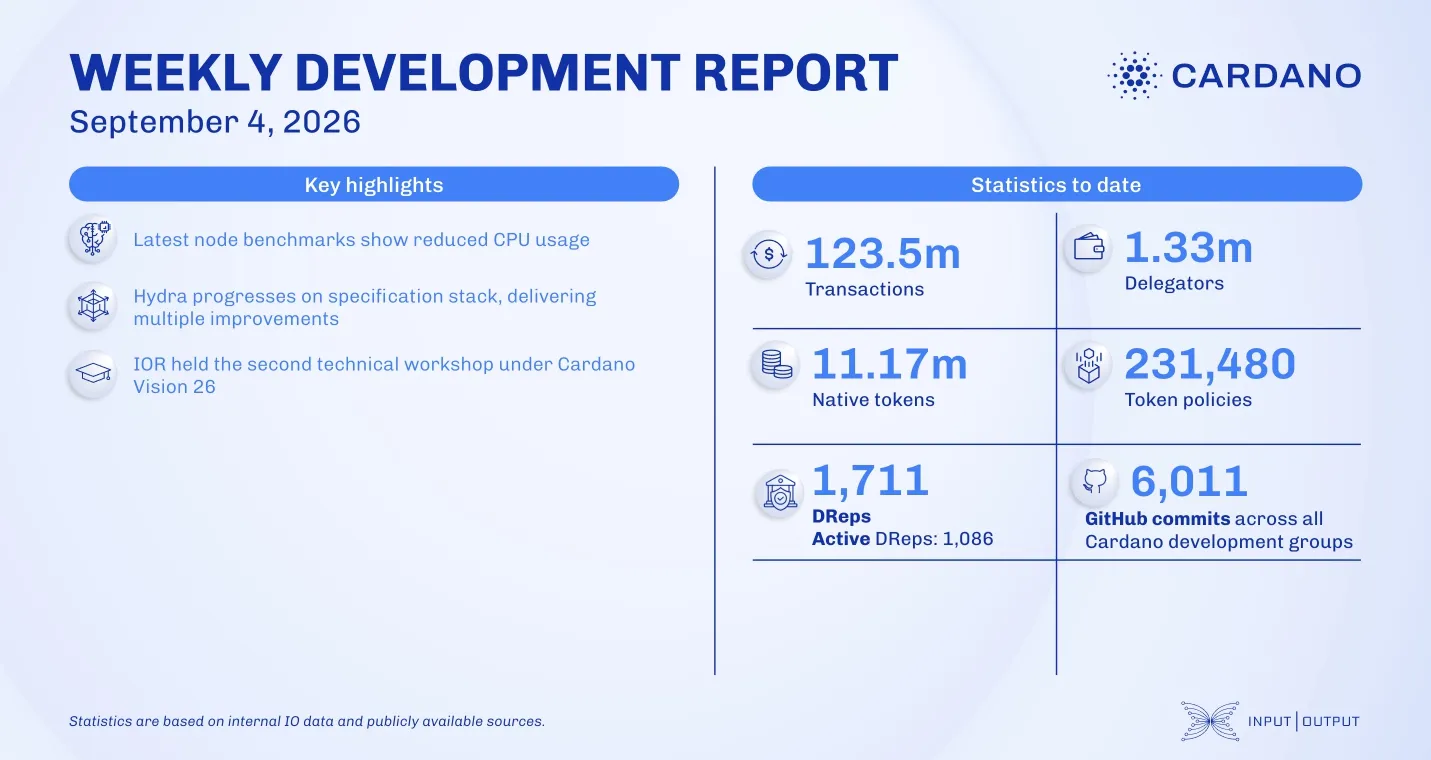
Benchmarks of Cardano node v.11.1.0 showed reduced CPU usage alongside a memory increase that is being addressed in the v.11.1.1 patch release. The Hydra team moved its specification to Typst, formalized it in Agda, and published native Linux ARM64 node images alongside AMD64, with faster Blockfrost query caching. The research team held its second Cardano Vision 26 workshop, covering data availability requirements and specifications.

Weekly Development Report

Weekly Development Report

Input Output Global
Global IO holding

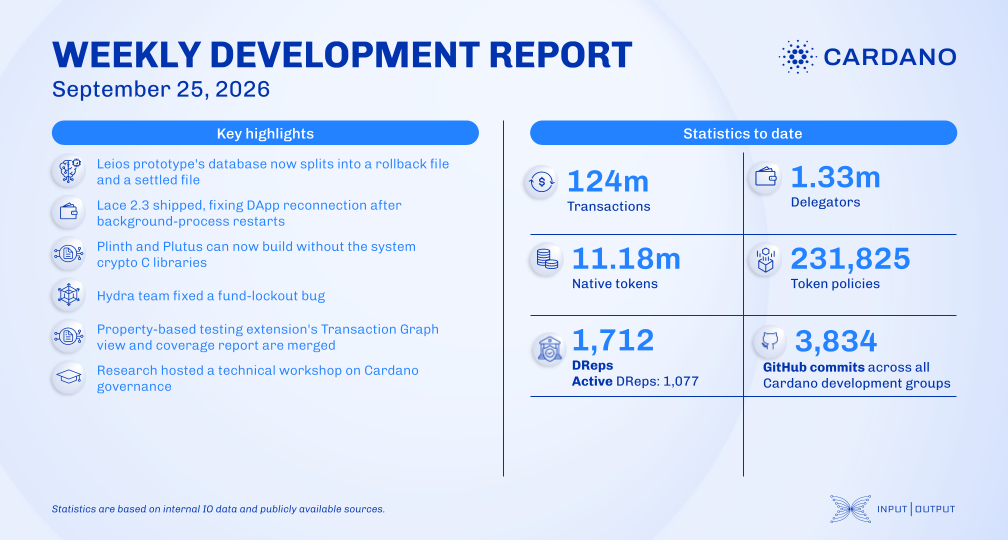
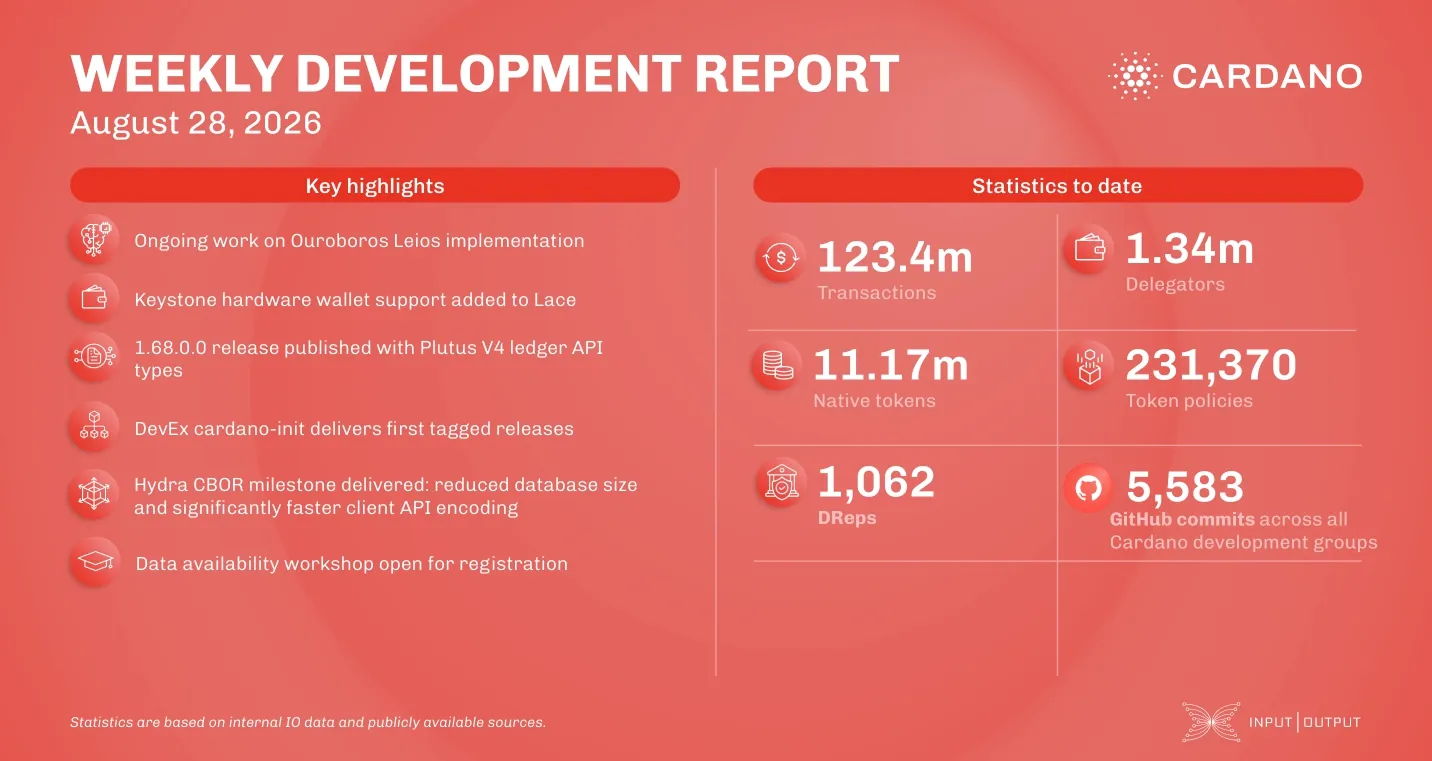
Lace added support for the Keystone hardware wallet in both the browser extension and the mobile app, bringing the wallet to four supported devices. The Plutus team published release 1.68.0.0 with Plutus V4 ledger API types, cardano-init reached its first tagged releases, and Hydra moved persisted event payloads to CBOR, shrinking a three-node benchmark database by more than half. Plinth also gained a one-command install script.

Weekly Development Report

Java developers already know how to build on Cardano

Cardano Foundation
Not-for-profit organization

Java developers can build on Cardano with the tools they already use, according to a Cardano Foundation walkthrough of the open-source BloxBean stack. Adding a dependency, writing a test and calling a REST endpoint cover most of what is needed, while the extended UTXO model and validator scripts can be learned gradually alongside. The post also previews three experimental Java projects now in development.

Java developers already know how to build on Cardano

Weekly Development Report

Input Output Global
Global IO holding

The Leios team completed the Earth phase of MusashiNet, the public testnet, after 41 days that produced over 127,000 blocks and grew participation from three pools to 63. Under synthetic load the network peaked at roughly six times the throughput Praos reaches on mainnet today. The ledger team extended pool distribution with BLS keys, and the Water phase is now open on a fresh chain.

Weekly Development Report

Weekly Development Report

Input Output Global
Global IO holding

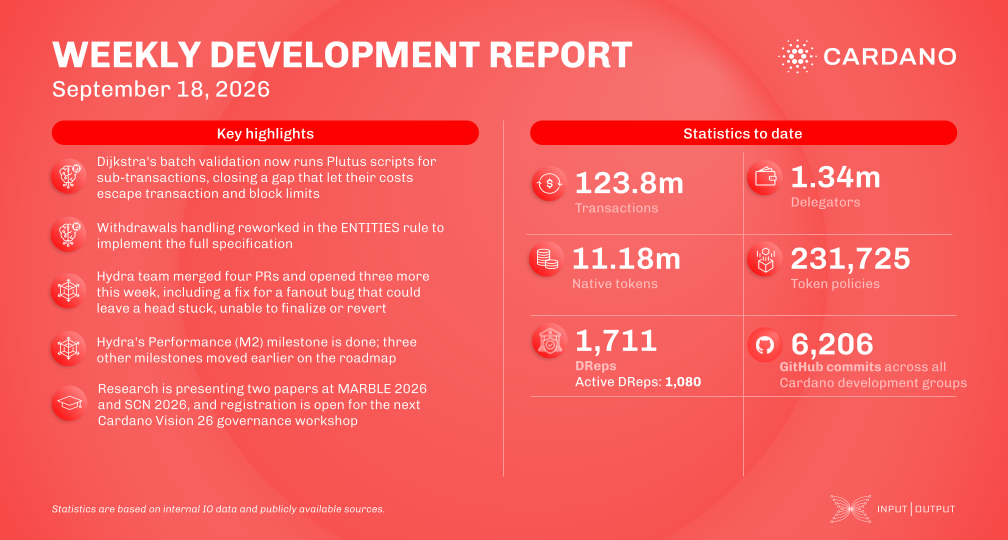
The consensus team released prototype-2026w32, with the node now announcing endorser blocks to peers as a first step toward announcement-based diffusion. Ouroboros-consensus 4.0.0.0 and 4.1 enabled the node to hard fork into the Dijkstra era. The Plutus team opened CIP-0194, CIP-0195 and a new problem statement for community review, and Hydra began rejecting deposits too large to ever be claimed.

Weekly Development Report

Weekly Development Report

Input Output Global
Global IO holding

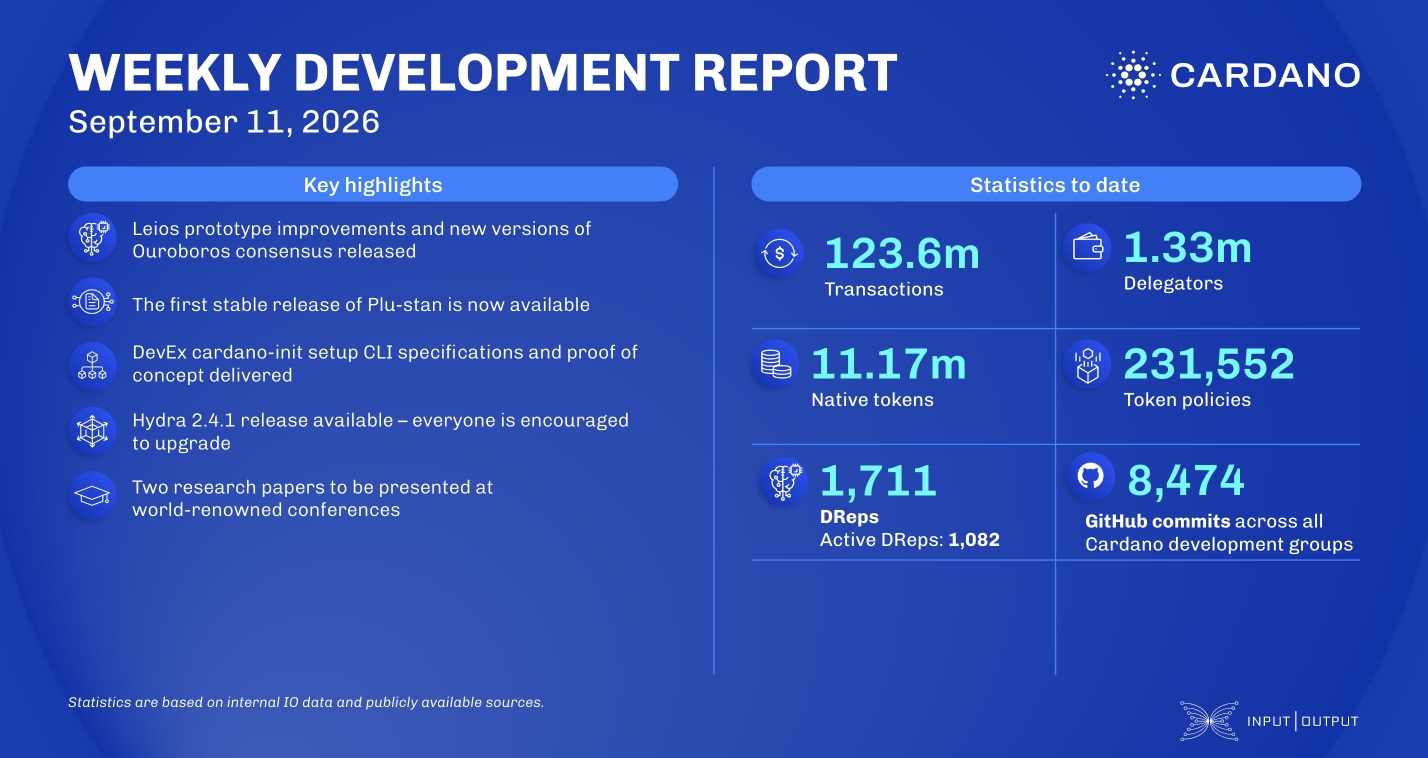
The performance and tracing team completed Van Rossem hard fork benchmarks, while the ledger team advanced Dijkstra nested transactions and implemented CIP-50 pledge-leverage-based staking rewards. Hydra released 2.3.0 with a significant snapshot-processing speedup, YAML node configuration, and native HD wallet key support. The developer experience team completed its Community Alignment deliverable with a live ecosystem map, and IO research opened the Cardano Vision '26 Mid-Year report for community feedback.

Weekly Development Report

Weekly Development Report

Input Output Global
Global IO holding

The consensus team released prototype-2026w29, enabling endorser block certification inside the forging loop to raise throughput, and extended the LeiosNotify mini-protocol toward the full block-announcement flow. Lace 2.2 introduced Bitcoin support for Ledger and Trezor hardware wallets, added SeedSigner air-gapped signing, and published the results of an independent security audit. Plutus implemented the multiIndexArray and policies built-ins from CIP-0156 and CIP-0168, gated behind the Dijkstra era, while Mithril completed IVC SNARK benchmarks and prepared the 2630 distribution.

Weekly Development Report

Weekly Development Report

Input Output Global
Global IO holding

The ledger team continued Leios integration and implemented CIP-181, removing the DRep-delegation requirement for reward withdrawals. The Lace wallet update introduced in-app swaps, CardanoCube integration, and Ledger and Trezor hardware wallet support. The Mithril team completed its non-recursive SNARK proof refactoring and upgraded the midnight-zk library. An Intersect treasury withdrawal of ₳25.4M was ratified to fund technical stewardship and governance coordination.

Weekly Development Report

Weekly Development Report

Input Output Global
Global IO holding

The consensus team stabilized the Leios testnet with two prototype builds and a voting dashboard for endorser block observability. The High Assurance team shipped the Plinth Static Analyzer on the Visual Studio Marketplace and a JSON-RPC backend for property-based testing. Mithril completed the SNARK recursive circuit modularity work and upgraded the midnight-zk library. Under Voltaire, the van Rossem hard fork passed ratification and will enact at the next epoch boundary, advancing Plutus ahead of the Dijkstra era that introduces Ouroboros Leios. The research team published the Cardano Vision 2026 Mid-Year Progress and Transparency Report draft for community feedback.

weekly development report

Aiken’s BLS12-381 Primitives Wide Possibilities Explained

Cardano Foundation
Not-for-profit organization

Cardano's Plutus Core ships first-class built-in primitives for the pairing-friendly BLS12-381 elliptic curve, exposing scalar multiplication, point addition, hash-to-curve, and pairing checks that any Plutus or Aiken script can run natively without external services or trusted oracles. The article walks through the curve and the Aiken API, then builds four concrete protocols on top of those primitives: BLS signature aggregation and multi-sig, key derivation from passwords and seeds, verifiable random functions for privacy and leader selection, and BBS+ signatures for anonymous credentials with selective disclosure. A follow-up will compose the same primitives into zk-SNARKs and polynomial commitment schemes.

aiken primitives explained