Wer mit Cardano arbeitet








Cardano im Einsatz
- Transaktionen auf Cardano in 30 Tagen
- 2.638.642
- davon vorgestellten Apps zugeordnet
- 342.467
- ausgewählte Apps zum Entdecken
- 103
- Jahre im Mainnet
- 9
Momentaufnahme der 30 Tage vom 21. September bis 21. Oktober 2026.
Die aktivste App je Kategorie, gemessen an On-Chain-Transaktionen im selben Zeitraum.


Was macht Cardano anders?
Planbar von Grund auf
Extended-UTXO-Modell
Eine Cardano-Transaktion gibt bestimmte Outputs aus und erzeugt neue. Ihr Ergebnis und ihre Gebühr lassen sich deshalb prüfen, bevor sie abgeschickt wird. Eine Transaktion kann viele Inputs und Outputs haben und so mehrere Empfänger bezahlen oder mehrere Trades auf einmal abwickeln. Die Gebühren folgen einer festen Formel aus Protokollparametern, nicht einer Auktion.
Staking ohne Haken
Non-Custodial, liquides Staking
Wenn du Ada an einen Stake-Pool delegierst, verlassen sie nie deine Wallet. Es gibt keine Sperrfrist, keinen Mindestbetrag und kein Slashing: Das Protokoll kann dir keine Ada als Strafe abziehen. Für die Registrierung deines Stake-Schlüssels hinterlegst du eine Kaution, die du zurückbekommst. Ausgeben oder neu delegieren kannst du jederzeit.
Direkt auf der Chain gesteuert
On-Chain-Governance und Treasury
Protokolländerungen, Treasury-Ausgaben und sogar die Verfassung werden on-chain vorgeschlagen und entschieden. Ada-Halter machen mit, indem sie ihre Stimmkraft an eine Vertretung delegieren oder sich selbst als Vertretung registrieren. Stake-Pool-Betreiber und ein Constitutional Committee sorgen für gegenseitige Kontrolle.
Auf Forschung gebaut
Peer Review und formale Methoden
Cardanos Kernprotokolle entstanden zuerst als wissenschaftliche Forschung, wurden von anderen Kryptografen begutachtet und dann umgesetzt. Der Node ist in Haskell geschrieben und der Ledger mit formalen Methoden gebaut, sodass sich der Code gegen seine Spezifikation prüfen lässt.
Aktuelle News
Bleib auf dem Laufenden über die neuesten Entwicklungen, Ankündigungen und Community-Updates aus dem Cardano-Ökosystem.
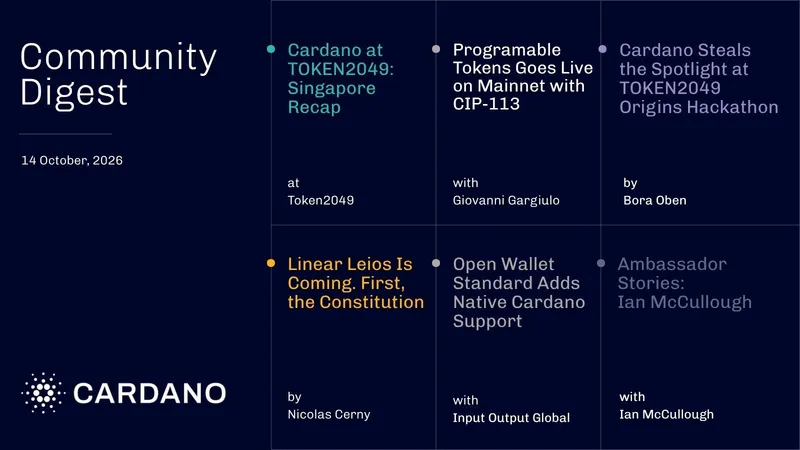
TOKEN2049 booth draws 2,000+ visitors as Origins teams build for the agentic economy
Cardano's 108 m² Singapore booth hosted projects from across the ecosystem, the Origins hackathon crowned three agent-payment builds, and CIP-0113 reached mainnet.
Cardano Foundation makes a transparency-first case for tokenized assets at TOKEN2049
CIP-0113 went live on mainnet, Veridian spun out with shares tokenized under the standard, and Fireblocks is due to custody native tokens for institutions.

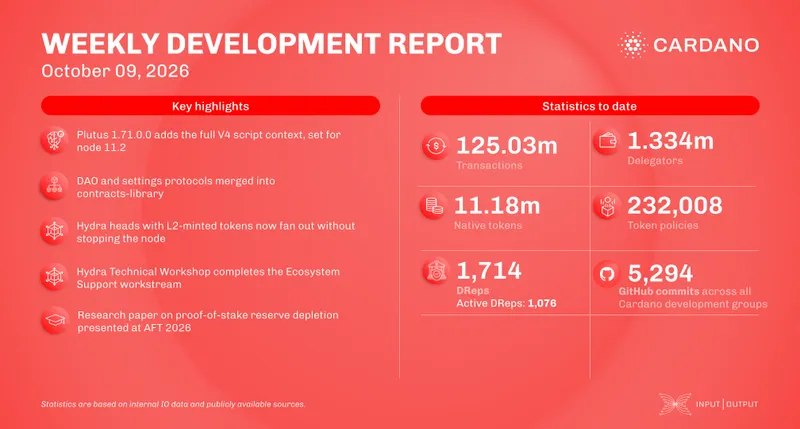
Plutus 1.71.0.0 adds the full V4 script context ahead of node 11.2
Plutus Core 1.2.0 and the keepPolicies and dropPolicies cost models both arrive in release 1.71.0.0, and DAO and settings protocols land in contracts-library.

DijkstraNet is coming with node 11.2 as CAP-12 returns with tighter guardrails
The public DijkstraNet will run alongside MusashiNet for dApp integrations, and node 11.3 targets a hard fork release candidate.
Cardano Foundation's .ada bid advances in ICANN's New gTLD Program
The application cleared Reveal Day and now faces technical, financial, and operational evaluation, with delegation of new top-level domains expected between 2028 and 2030.
Petrobras traces aviation fuel and renewable diesel claims on Cardano
A Book-and-Claim model ties aviation fuel certificates to verifiable claims, and production, transport, and use checkpoints cover renewable diesel, both with PUC-Rio's Ledger Labs.