Zum Hauptinhalt springen

Cardano News

Explore the stories below for curated news, stories, and inspiration from within the Cardano ecosystem.

Layer 2 expansion: beyond Hydra

Input Output Global
Global IO holding

A June 23, 2025, blog post by Fergie Miller summarizes a Cardano R&D session on Layer-2 expansion beyond Hydra. The session featured presentations on Midgard (an optimistic rollup), a zk-rollup from zkFold SA, a ZK bridge from Eryx Cooperativa, and Gummiworm (a scalable rollup from Sundae Labs). Key discussion themes included interoperability, capital fragmentation, and the importance of security.

To slash or not to slash: that is the blockchain question

Input Output Global
Global IO holding

A June 23, 2025, IOHK blog post by a team of researchers explores the concept of slashing as a security mechanism in blockchains. It contrasts Ethereum's slashing-based model, where validators risk losing staked assets for misbehavior, with Cardano's non-slashing approach. The authors argue that slashing is ineffective against majority attacks and can deter participation, while Cardano’s method, relying on formal verification and stake-weighted incentives, provides robust security without these drawbacks.

Ouroboros Genesis

Understanding Cardano: introducing the Cardano Blueprint

Input Output Global
Global IO holding

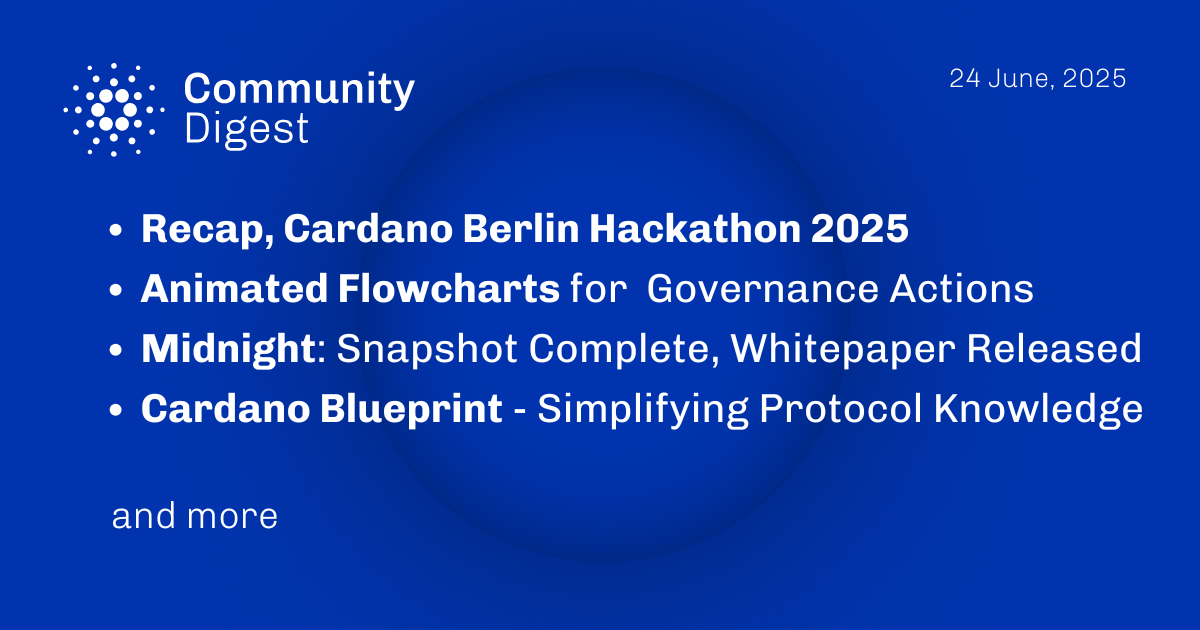
On June 20, 2025, Input Output Global (IOG) introduced the Cardano Blueprint, a comprehensive, open-source reference guide to the platform. This living document is designed to be a single source of truth, detailing Cardano's core components, architecture, protocols, and design principles. The Blueprint aims to enhance transparency and accessibility for developers, researchers, and the wider community. By providing a standardized technical reference, it seeks to improve the onboarding process and foster a deeper understanding of Cardano's intricacies.

Ouroboros Genesis

Weekly Development Report

Input Output Global
Global IO holding

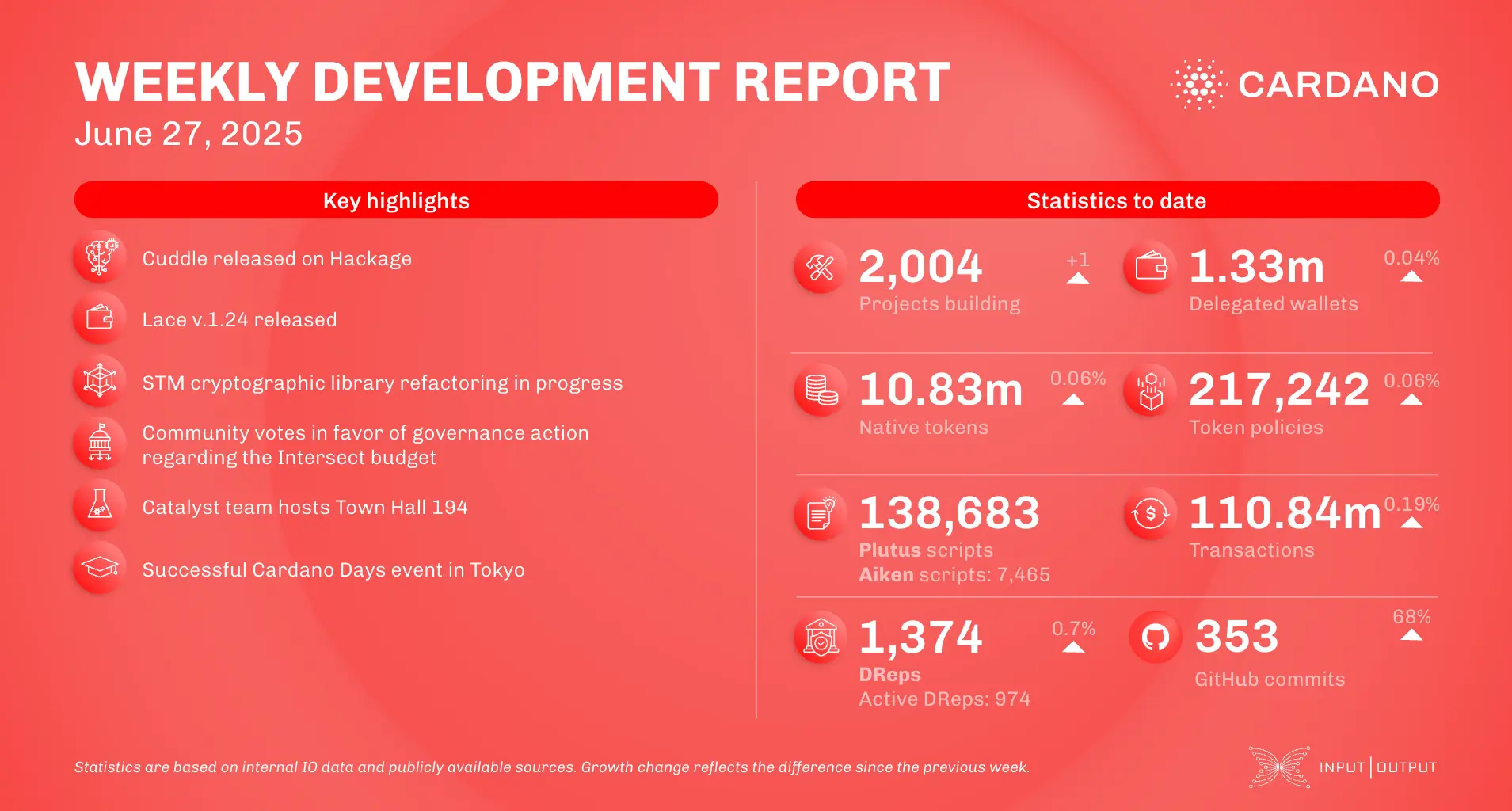
The June 20, 2025, development report highlights significant work by the ledger team to modernize the codebase and prepare for an upcoming intra-era hard fork. This included enhancing CDDL specifications, reducing technical debt, and conducting preliminary work on nested transactions. The report also touched upon future node improvements like log-structured merge (LSM) trees and revised stake pool incentives. Governance participation continued to grow, with an increase in the number of registered DReps.

weekly development report

Transforming Verification with UVerify

Cardano Foundation
Not-for-profit organization

In this session of the Cardano Developer Office Hours, Fabian Bormann, Team Lead of Ecosystem Engineering at the Cardano Foundation, presents UVerify, a lightweight tool for certifying and verifying data on Cardano without tokens or NFTs. He covers datums as an alternative to metadata, SDKs and white-label tools for devs, and real-world use cases like documents, credentials, and oracles. A live demo shows UVerify in action. The roadmap explores frictionless integrations and future opportunities for verifiable interactions across ecosystems.

Weekly Development Report

Input Output Global
Global IO holding

The June 06, 2025, development report highlights the release of Lace wallet v.1.23, which features a more accurate pricing feed for Cardano native tokens in response to community feedback. On the scaling front, the Mithril team delivered support for node v.10.4.1 and UTXO-HD in their tools and advanced the development of the DMQ node. The Leios team finalized an analysis of overcollateralization models and progressed on their Rust-based simulation framework for evaluating transaction duplication and conflict likelihood.

weekly development report

Cardano Foundation Introduces Originate for Verifiable Authenticity

Cardano Foundation
Not-for-profit organization

The Cardano Foundation has launched Originate, an open-source traceability solution built on the Cardano blockchain. It enables businesses to verify product authenticity and support certifications, enhancing supply chain transparency and combating counterfeiting. A successful case study in the Georgian wine industry demonstrated its effectiveness in fighting counterfeit products. Originate provides a secure, scalable, and cost-effective way for industries like luxury goods and pharmaceuticals to increase consumer trust. The code is available on GitHub for community contribution.

weekly development report

Community Digest

Cardano Foundation
Not-for-profit organization

The June 11, 2025, Cardano Community Digest highlights a focus on the Ouroboros Leios consensus protocol, explaining its significance for the network's future. It also provides a recap of the June 5th Stake Pool Operator call through notes from Rick McCracken. Additionally, the digest covers the recent Azteca 2025 community events in Mexico and features a spotlight on the FRADA stake pool, showcasing different aspects of the ecosystem.

community digest

Cardano node's evolution towards diversity and modular design

Input Output Global
Global IO holding

A blog post by Input Output Global (IOG) from June 06, 2025, details the evolution of the Cardano node from a monolithic application into a modular framework. This transformation breaks the node into smaller, independent components for aspects like consensus, ledger, and networking. The post explains that this modular design enhances flexibility for developers, simplifies updates, and critically, fosters client diversity. By enabling the creation of alternative node clients, this evolution aims to improve the overall resilience of the Cardano network.

Ouroboros Genesis

Weekly Development Report

Input Output Global
Global IO holding

The June 06, 2025, development report highlights the release of Lace wallet v.1.23, which features a more accurate pricing feed for Cardano native tokens in response to community feedback. On the scaling front, the Mithril team delivered support for node v.10.4.1 and UTXO-HD in their tools and advanced the development of the DMQ node. The Leios team finalized an analysis of overcollateralization models and progressed on their Rust-based simulation framework for evaluating transaction duplication and conflict likelihood.

weekly development report