Cardano News

Explore the stories below for curated news, stories, and inspiration from within the Cardano ecosystem.

Blockchain Basics: A Simple Guide for Beginners

Cardano Foundation
Not-for-profit organization

Blockchain technology, initially linked to cryptocurrencies, now impacts various sectors by offering a decentralized, secure method for data management. A blockchain is a digital ledger of cryptographically linked data blocks, ensuring immutable records across a network of nodes. Unlike cryptocurrencies, blockchain serves broader applications beyond digital currency transactions.

Invented by Stuart Haber and W. Scott Stornetta, and popularized by Satoshi Nakamoto's Bitcoin white paper, blockchain addresses double-spending issues. It operates through nodes validating transactions, forming secure, tamper-proof records. Blockchain types include public, private, consortium, and hybrid, each suited for different use cases like supply chains, legal processes, digital assets, intellectual property, and voting systems.
Blockchain Basics

Cardano Foundation brings MiCA compliance to the Cardano network

Cardano Foundation
Not-for-profit organization

Cardano Foundation and Crypto Carbon Ratings Institute (CCRI) released MiCA-compliant sustainability indicators for the Cardano network. This ensures compliance with upcoming EU Markets in Crypto-Assets (MiCA) regulation. Key findings include Cardano's energy-efficient protocol, annual electricity consumption of 704.91 MWh, carbon footprint of 250.73 tCO2e, and marginal power demand per TPS of 0.192 W. The report, developed using scientific methodologies, aims to enhance transparency and sustainability, setting a benchmark for blockchain networks. Leaders from both organizations emphasized the importance of sustainability and regulatory compliance in the crypto sector.

banner

Cardano Survives a Denial of Service Attack

Cardano Community
Individuals interested in or actively supporting the Cardano blockchain

Lloyd Duhon discusses the recent attack on Cardano. Despite the attack, the network only slowed down slightly, with most services unaffected. The attacker used spam transactions, but Cardano’s structure made it complex and costly. A flaw in the attacker’s contract allowed Phil from Anastasia Labs to counter with a “deregistration attack,” stopping the hacker and retrieving ada. Staked ada was never at risk. Cardano’s design ensures resilience, requiring significant resources to sustain such attacks. The community’s quick response and Cardano’s robust design minimized the impact.

Weekly Development Report

Input Output Global
Global IO holding

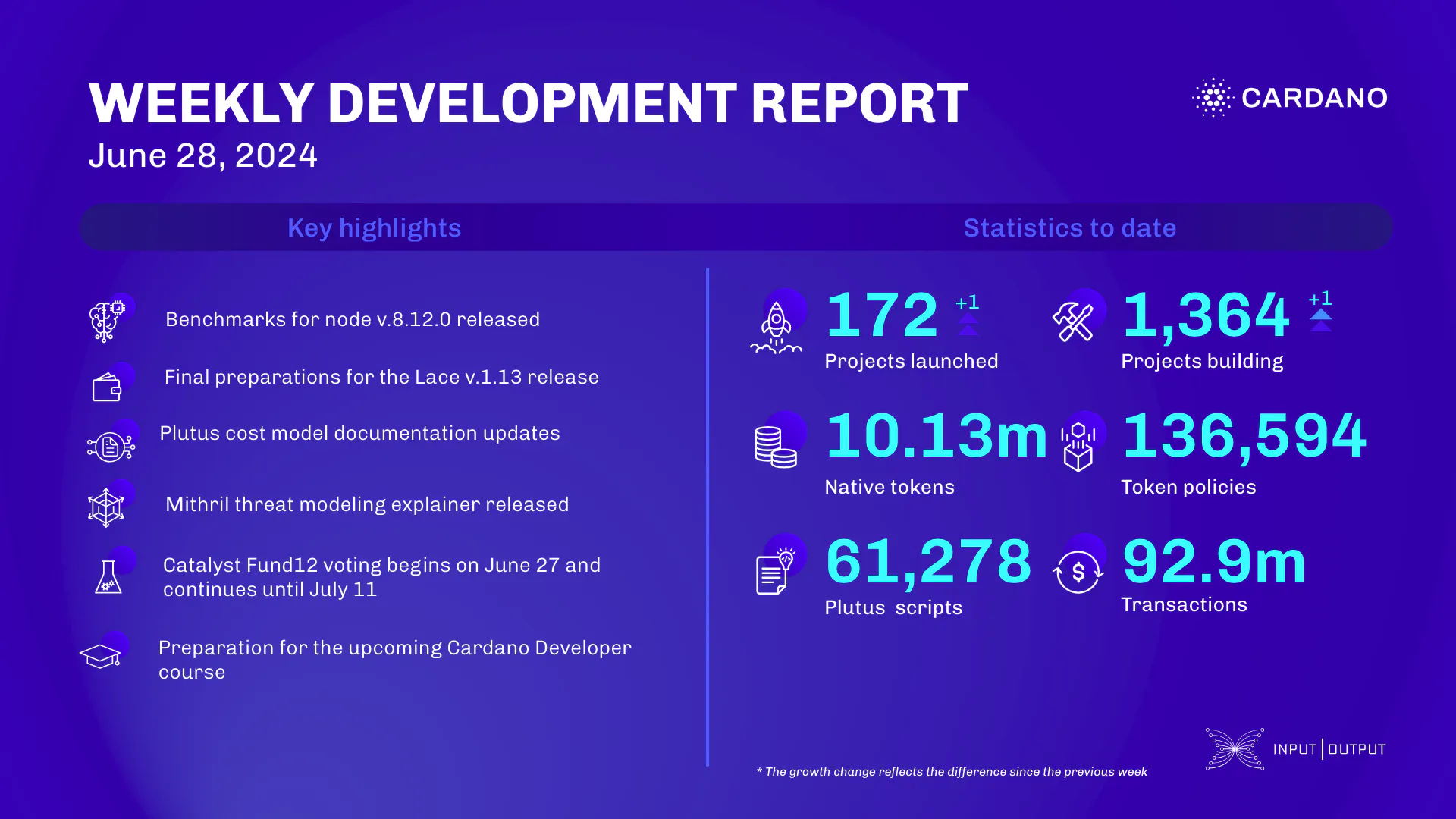
The consensus team optimized db-truncater for speed, supported debugging for bootstrap nodes, and released benchmarks for node v.8.12.0. They also merged a performance fix for node v.8.11, worked on governance action workload, and updated automations for Conway features and the Plutus cost model. The Plutus team overviewed the cost model, designed faster pattern matching, and improved documentation. The Mithril team released a threat modeling explainer, worked on Cardano transaction certification, and improved WASM client documentation. Catalyst released a shortlist of tier-one companies for voting, and the education team updated the Mastering Cardano series and prepared for next month’s developer course.

weekly development report

Cardano Integrates Inter-Blockchain Communication Protocol

Cardano Foundation
Not-for-profit organization

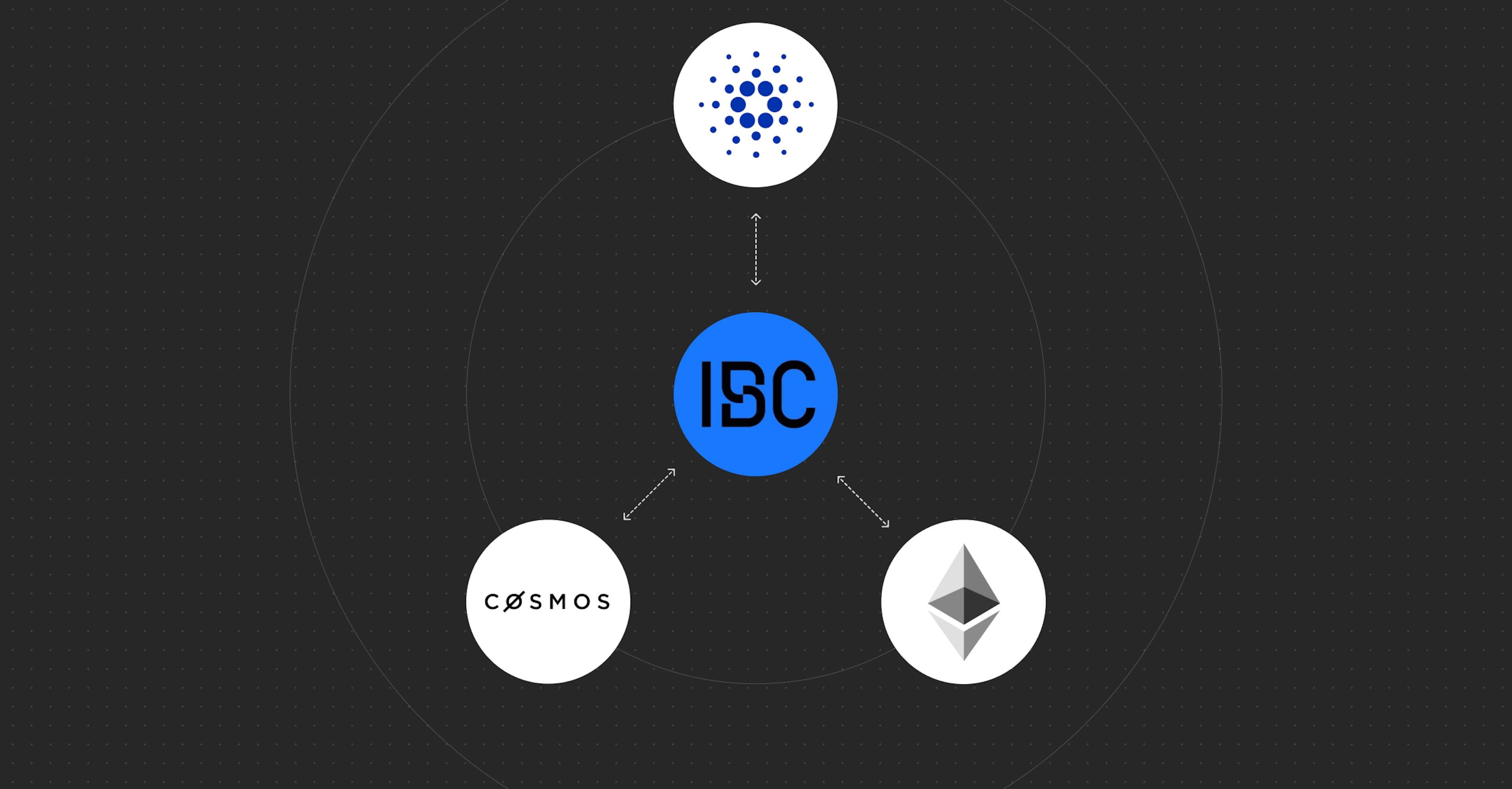
The Cardano Foundation has integrated the Inter-Blockchain Communication Protocol (IBC) to enhance connectivity and join the interchain ecosystem, addressing challenges in scalability, data privacy, and interoperability. This integration allows reliable transactions and data exchanges across distinct blockchain networks, linking Cardano to over 115 interconnected blockchains and enabling Ethereum Virtual Machine (EVM)-based sidechains. The IBC sidechain improves enterprise blockchain deployment by offering flexibility, scalability, cross-platform innovation, operational efficiency, and security. This move aims to broaden blockchain scalability, reach, and connectivity, benefiting enterprises and developers alike.

Cardano Integrates Inter-Blockchain Communication Protocol

Community Digest

Cardano Foundation
Not-for-profit organization

The Interim Constitution was released on June 21, 2024, serving as a temporary document until the Final Constitution is ratified by ada holders by early 2025. Drafting of the final constitution will involve global workshops and a Constitutional Convention. The Interim Constitutional Committee election ended on June 24, 2024, with results expected on June 26 after an audit. The Aiken team reports surpassing 1 million Mainnet transactions with Aiken smart contracts, contributing to 25% of all smart contract traffic. MinSwap completed its final audit on their new Aiken-based implementation, anticipating increased activity. A new full-time engineer, Riley, joins the team, with new libraries and features like property-based testing and backpassing being showcased in projects like Merkle-Patricia Forestry and Fortuna.

community digest

Monthly Cardano Scaling Report

The Mithril project in June saw the release of distribution 2423.0, including critical updates like removing the deprecated snapshot command and improving transaction certification performance. Work on Cardano integration progressed, focusing on decentralizing signature diffusion. The Hydra project made significant strides with incremental decommits, updating the protocol's specification, and fixing a critical bug in the decommit feature. They also made breaking changes to the hydra-node API and enhanced the system's security and efficiency, with a planned release in the near future.

Cardano's Interim Constitution Explained

Cardano Community
Individuals interested in or actively supporting the Cardano blockchain

Lloyd Duhon breaks down the Cardano Blockchain Interim Constitution, covering its preamble, core principles, community members’ rights and responsibilities, and the transition plan to the Final Constitution. Discover how this document paves the way for a fully decentralized, community-governed blockchain. Essential insights for Cardano enthusiasts, blockchain developers, and those curious about crypto governance.

Weekly Development Report

Input Output Global
Global IO holding

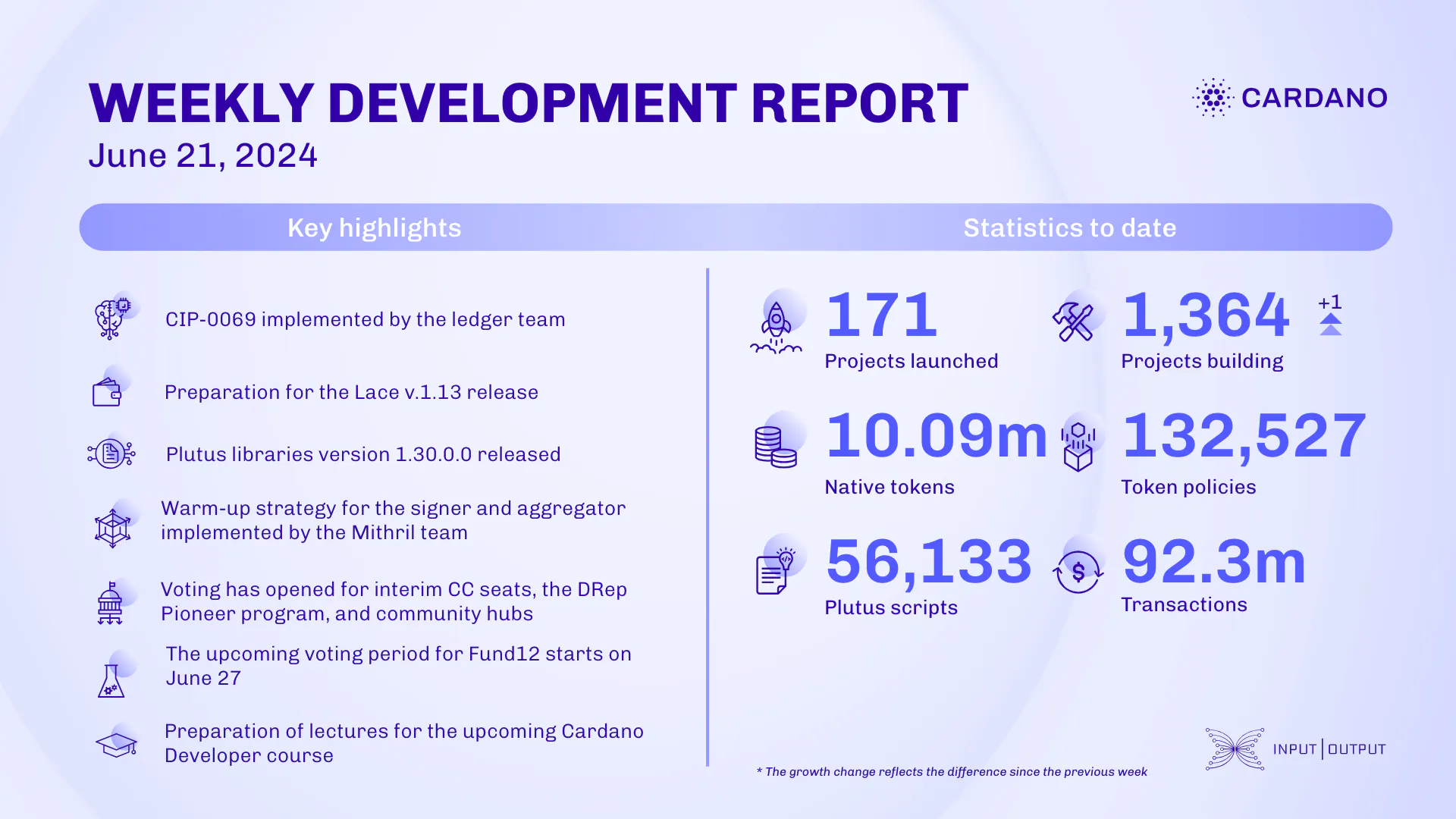
This week, the ledger team implemented CIP-0069, enhancing PlutusV3 functionality by making spending datums optional and enforcing single arguments for scripts. They also fixed script execution and delegation bugs. The Lace team prepares for v.1.13 release. The Plutus team released version 1.30.0.0, featuring CIP-0122 and ledger API refactoring. The Mithril team improved transaction certification and throughput. Voltaire & SanchoNet updates include member-experience improvements and upcoming votes. Catalyst town hall 167 marked the end of community moderation for Fund12, with voting starting June 27. The education team prepares for next month’s Cardano Developer course.

weekly development report

Understanding Leios, with Pi Lanningham & Arnaud Bailly

Cardano Community
Individuals interested in or actively supporting the Cardano blockchain

The roundtable discussion features Pi Lanningham and Arnaud Bailly exploring the intricacies of Ouroboros Leios, a blockchain-based technology aimed at enhancing decentralized systems. They delve into Leios's architecture, its potential applications in the tech industry, and the innovative solutions it offers for scalability and security. The conversation also covers the implications of Ouroboros Leios for developers and businesses, highlighting its unique approach to consensus and transaction processing. This insightful dialogue provides a comprehensive understanding of how Leios could revolutionize blockchain technology and its real-world applications.