Working with Cardano









Cardano in use
- transactions on Cardano in 30 days
- 2,638,642
- attributed to showcased apps
- 342,467
- curated apps to explore
- 103
- years on mainnet
- 9
Snapshot of the 30 days from September 21 to October 21, 2026.
Most active app per category, by on-chain transactions in the same period.


What makes Cardano different?
Predictable by design
Extended UTXO model
A Cardano transaction spends specific outputs and creates new ones, so its result and its fee can be checked before it is submitted. One transaction can have many inputs and outputs, paying several recipients or settling several trades together. Fees follow a fixed formula set by protocol parameters, not an auction.
Staking without strings
Non-custodial, liquid staking
Delegating ada to a stake pool never moves it out of your wallet. There is no lock-up period, no minimum amount to delegate, and no slashing: the protocol cannot take your ada as a penalty. Registering your stake key takes a refundable deposit, and you can spend or re-delegate at any time.
Governed on the chain itself
On-chain governance and treasury
Protocol changes, treasury spending and even the constitution are proposed and decided on-chain. Ada holders take part by delegating their voting power to a representative or by registering as one themselves. Stake pool operators and a constitutional committee provide checks and balances.
Backed by research
Peer review and formal methods
Cardano's core protocols were designed as academic research first, reviewed by other cryptographers, then implemented. The node is written in Haskell and the ledger is built with formal methods, so the code can be checked against its specification.
Latest News
Stay up to date with the latest developments, announcements, and community updates from the Cardano ecosystem.
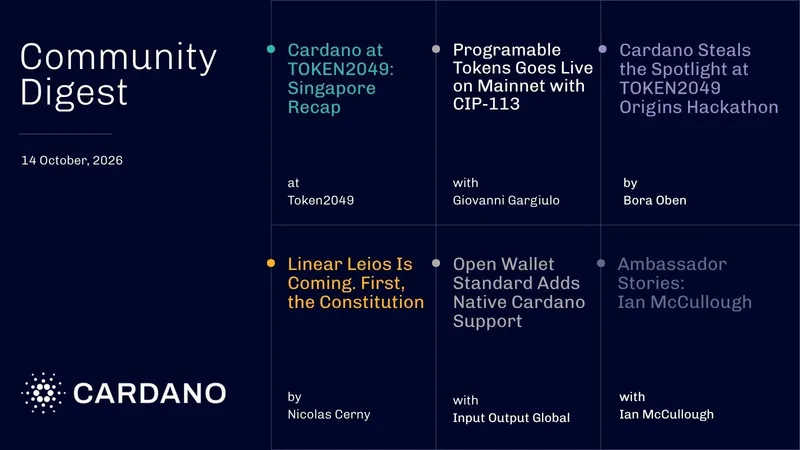
TOKEN2049 booth draws 2,000+ visitors as Origins teams build for the agentic economy
Cardano's 108 m² Singapore booth hosted projects from across the ecosystem, the Origins hackathon crowned three agent-payment builds, and CIP-0113 reached mainnet.
Cardano Foundation makes a transparency-first case for tokenized assets at TOKEN2049
CIP-0113 went live on mainnet, Veridian spun out with shares tokenized under the standard, and Fireblocks is due to custody native tokens for institutions.

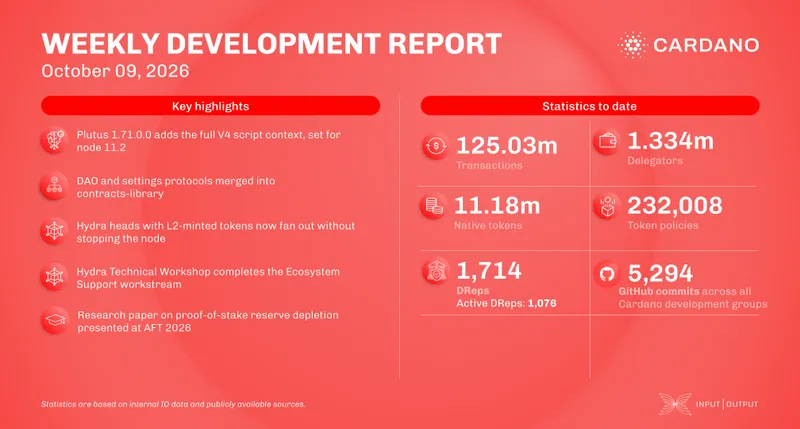
Plutus 1.71.0.0 adds the full V4 script context ahead of node 11.2
Plutus Core 1.2.0 and the keepPolicies and dropPolicies cost models both arrive in release 1.71.0.0, and DAO and settings protocols land in contracts-library.

DijkstraNet is coming with node 11.2 as CAP-12 returns with tighter guardrails
The public DijkstraNet will run alongside MusashiNet for dApp integrations, and node 11.3 targets a hard fork release candidate.
Cardano Foundation's .ada bid advances in ICANN's New gTLD Program
The application cleared Reveal Day and now faces technical, financial, and operational evaluation, with delegation of new top-level domains expected between 2028 and 2030.
Petrobras traces aviation fuel and renewable diesel claims on Cardano
A Book-and-Claim model ties aviation fuel certificates to verifiable claims, and production, transport, and use checkpoints cover renewable diesel, both with PUC-Rio's Ledger Labs.