Cardano News

Explore the stories below for curated news, stories, and inspiration from within the Cardano ecosystem.

Cardano Foundation and Reef Data eG announce partnership

Cardano Foundation
Not-for-profit organization

The Cardano Foundation partnered with Reef Data eG, a Hamburg-based data cooperative, to record payment flows transparently and auditably on the Cardano blockchain using Reeve, the Foundation's open-source reporting transparency platform. Reef Data developed the application layer, including a user wallet extension and public and auditor dashboards, while the Foundation provided and extended the Reeve Publisher and Data Reader services. The pilot demonstrates how sales, reward distributions, and member payouts can be verified on-chain by cooperative members and independent auditors.

Cardano Foundation and Reef Data eG partnership

Weekly Development Report

Input Output Global
Global IO holding

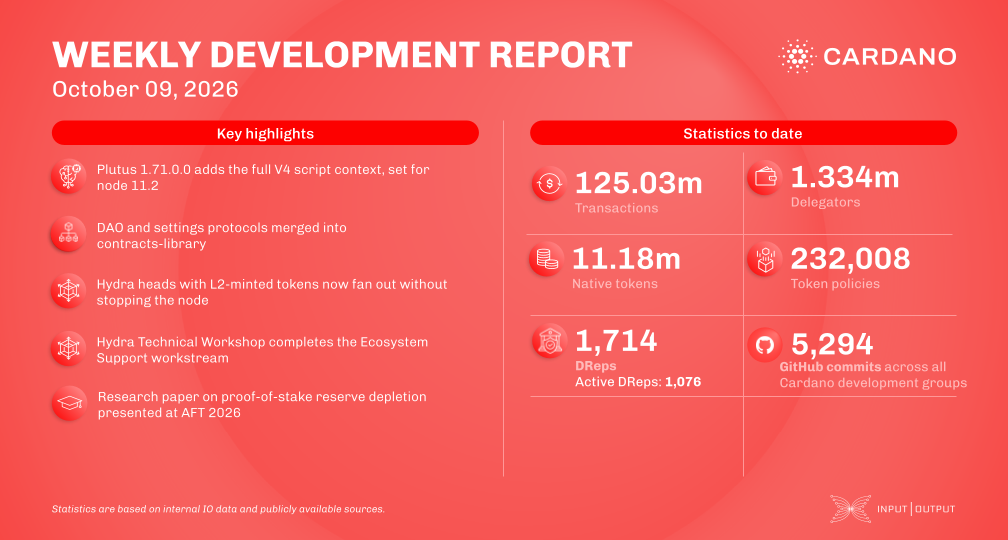
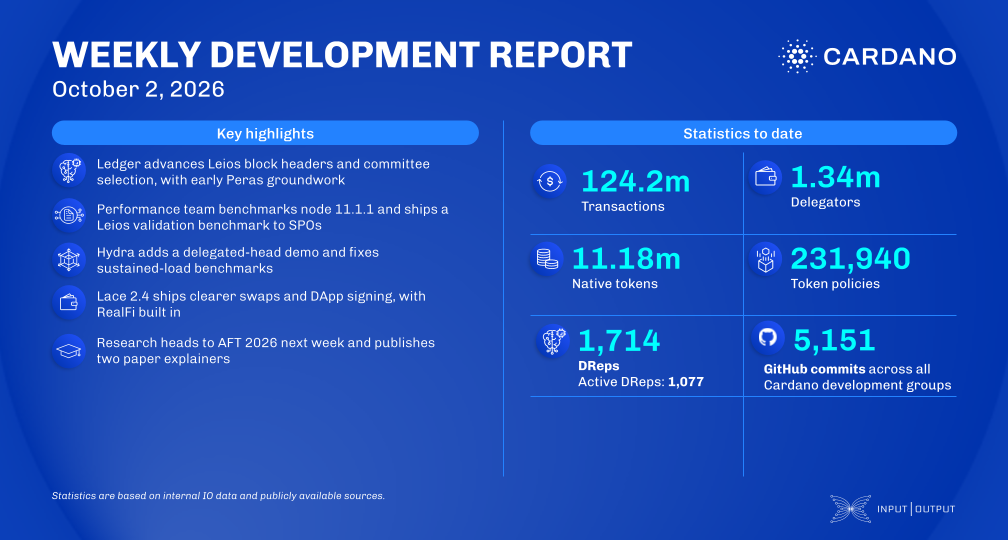
The ledger team continued Leios integration and implemented CIP-181, removing the DRep-delegation requirement for reward withdrawals. The Lace wallet update introduced in-app swaps, CardanoCube integration, and Ledger and Trezor hardware wallet support. The Mithril team completed its non-recursive SNARK proof refactoring and upgraded the midnight-zk library. An Intersect treasury withdrawal of ₳25.4M was ratified to fund technical stewardship and governance coordination.

Weekly Development Report

Community Digest

Cardano Community
Individuals interested in or actively supporting the Cardano blockchain

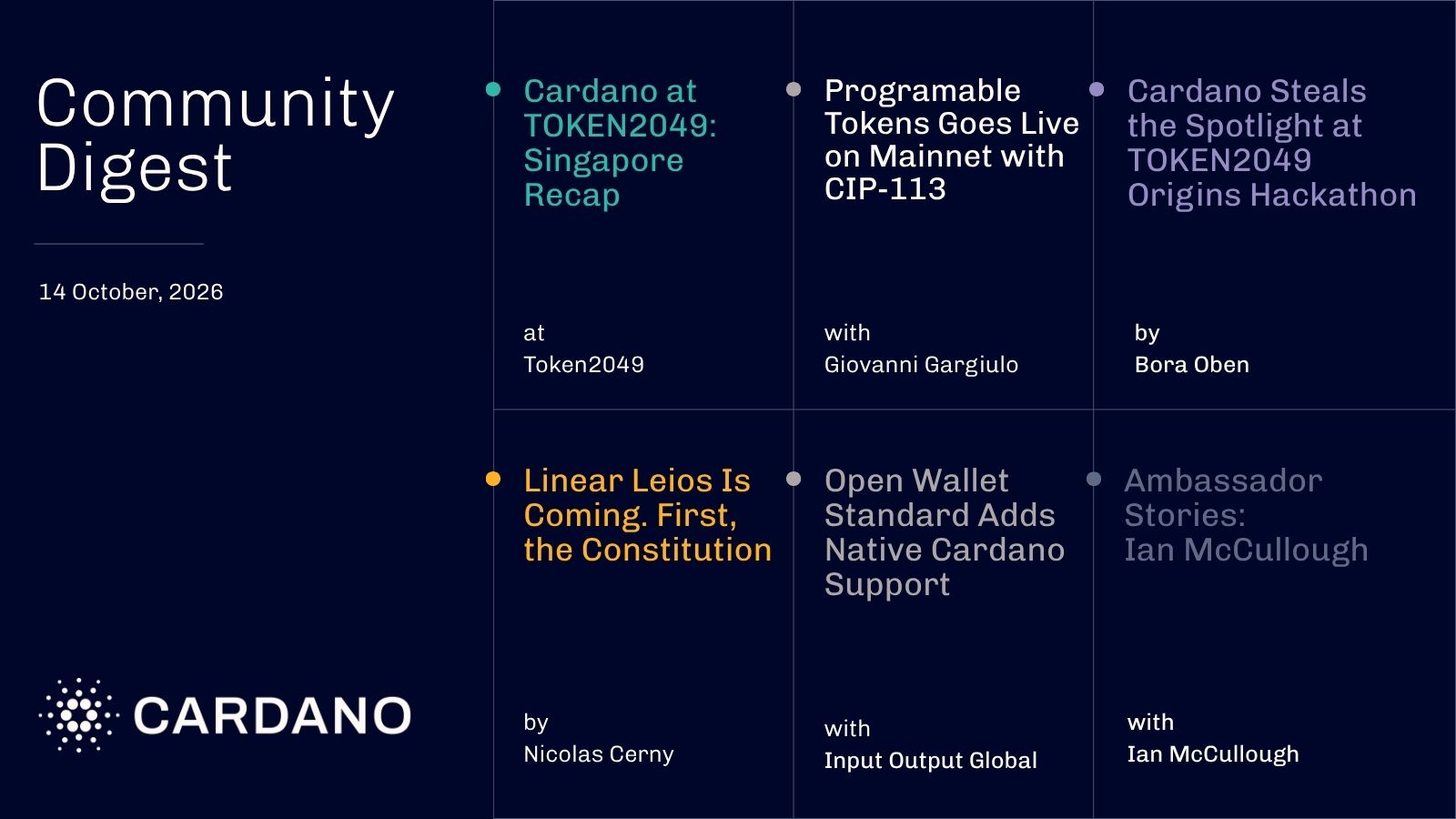
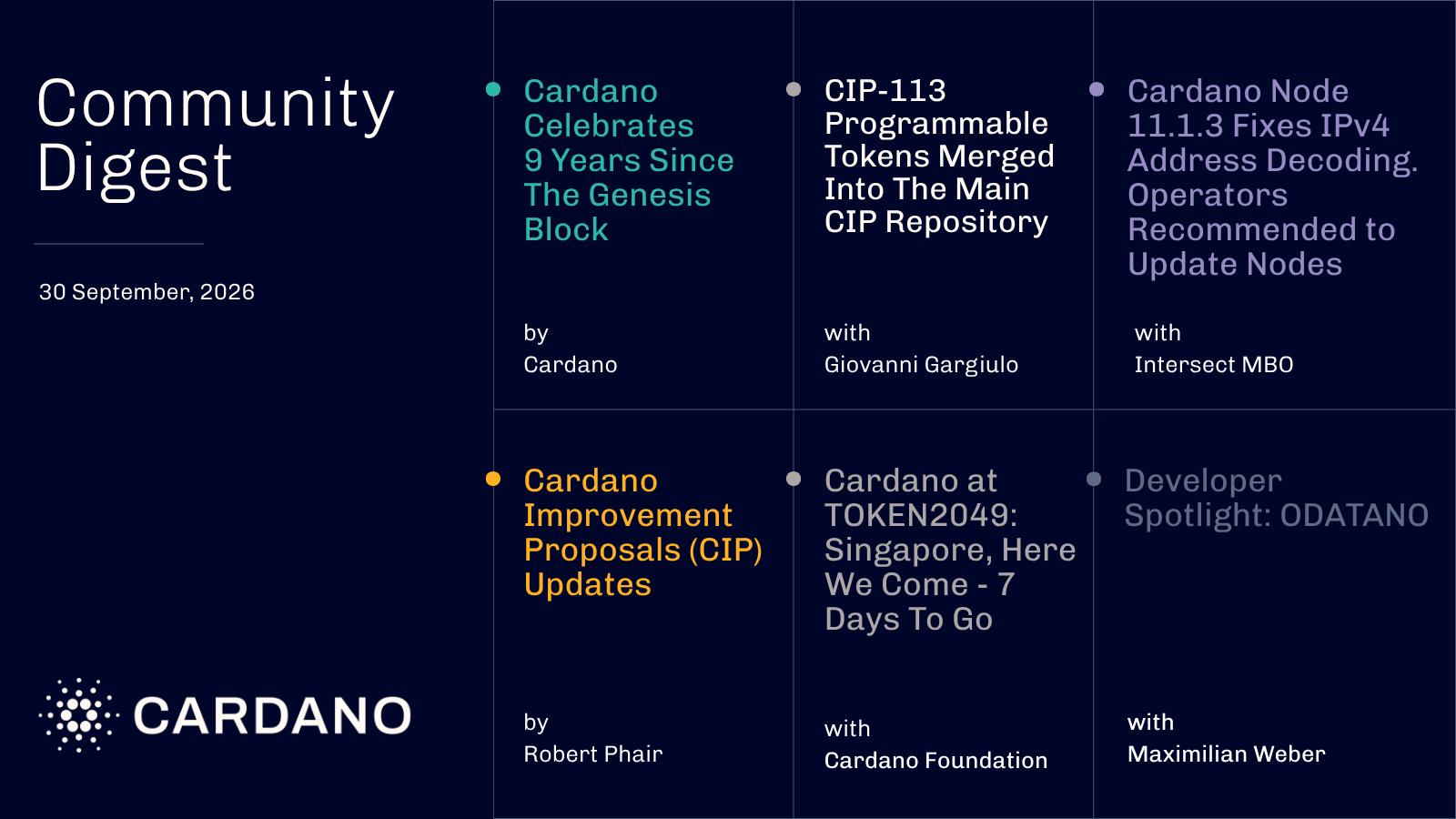
The Van Rossem hard fork activated at Protocol Version 11, marking Cardano's first hard fork proposed, debated, and ratified entirely through on-chain governance. The 2026 Constitutional Committee election entered its final voting days, with candidates discussing the role's realities in the latest Roundtable Talk. New CIPs, including stake pool pruning and handle provider registry updates, entered the review cycle. The Cardano Foundation joined the x402 Foundation and released new Aiken cryptography developer guides, while community spotlights covered Learn Cardano's AI-agent payments update and Linda's ecosystem analysis.

Community Digest

Weekly Development Report

Input Output Global
Global IO holding

The consensus team stabilized the Leios testnet with two prototype builds and a voting dashboard for endorser block observability. The High Assurance team shipped the Plinth Static Analyzer on the Visual Studio Marketplace and a JSON-RPC backend for property-based testing. Mithril completed the SNARK recursive circuit modularity work and upgraded the midnight-zk library. Under Voltaire, the van Rossem hard fork passed ratification and will enact at the next epoch boundary, advancing Plutus ahead of the Dijkstra era that introduces Ouroboros Leios. The research team published the Cardano Vision 2026 Mid-Year Progress and Transparency Report draft for community feedback.

weekly development report

Aiken’s BLS12-381 Primitives Wide Possibilities Explained

Cardano Foundation
Not-for-profit organization

Cardano's Plutus Core ships first-class built-in primitives for the pairing-friendly BLS12-381 elliptic curve, exposing scalar multiplication, point addition, hash-to-curve, and pairing checks that any Plutus or Aiken script can run natively without external services or trusted oracles. The article walks through the curve and the Aiken API, then builds four concrete protocols on top of those primitives: BLS signature aggregation and multi-sig, key derivation from passwords and seeds, verifiable random functions for privacy and leader selection, and BBS+ signatures for anonymous credentials with selective disclosure. A follow-up will compose the same primitives into zk-SNARKs and polynomial commitment schemes.

aiken primitives explained

Introducing the CANS protocol: unlocking Bitcoin liquidity for Cardano DeFi

Input Output Global
Global IO holding

Input Output's Cyclic Atomic N-party Swap (CANS) protocol arranges participants in a ring where each sends assets once and receives once, with the entire swap enforced as atomic: either everyone gets what they agreed to, or nobody loses anything. The design removes the need for bridges, wrapped tokens, or trusted intermediaries by making signatures conditionally valid behind a shared secret revealed only once every party has locked funds. A reference implementation in Rust, formally verified with up to 20 concurrent parties, shows the approach works in practice today, and any chain with native or verifiable Schnorr signatures can join a swap session.

introducing the cans protocol

Constitutional Committee Election 2026: Real Talk with the Candidates

Cardano Community
Individuals interested in or actively supporting the Cardano blockchain

A Cardano Community roundtable hosted three Constitutional Committee candidates to discuss what serving on the Committee involves as the 2026 election gets underway. Moderated by the Cardano Foundation governance lead, the session moved past a traditional candidate introduction to examine the practical realities of the role, including workload, transparency, constitutional interpretation, collaboration, and Committee fatigue. Candidates also addressed whether the current incentive model is sufficient to sustain long-term participation, giving DReps and observers a fuller view of the responsibilities and challenges ahead of the vote.

Weekly Development Report

Input Output Global
Global IO holding

The performance and tracing team removed the legacy iohk-monitoring tracing backend (roughly 11,000 lines) and RTView from cardano-tracer, while the ledger team extended StAnnTx memoization to Alonzo and merged the first Leios-related changes. In wallets, Lace released browser extension 2.1, headlined by a wallet security check feature. Under Voltaire, DRep voting is underway in the Constitutional Committee election ahead of the July 23 deadline, and the Research team advanced its Cardano Vision 2026 workstreams with the first zero-knowledge technical workshop.

Weekly development report

Community Digest

Cardano Community
Individuals interested in or actively supporting the Cardano blockchain

Applications are open for Draper University's Genesis Hacker House, a four week Silicon Valley residency for early stage teams building on Cardano, while Arouet Holdings is seeking candidates for its voluntary Community Director board role. The State of Cardano Governance 2026 report examines DRep participation, voting power concentration, and SPO engagement, with six recommendations to strengthen governance. RealFi launched its Phase 1 testnet, opening swap, stake, and unstake actions for its stablecoin based credit protocol, and several Cardano Improvement Proposals advanced through active review, including Proof of Existence metadata and DRep voting power concentration.

community digest