Cardano News

Explore the stories below for curated news, stories, and inspiration from within the Cardano ecosystem.

255 posts tagged with "Development"

Weekly development reports, protocol progress, tooling, and developer resources.

View all tags

Open Wallet Standard adds Cardano support in v1.4.3

Input Output Global
Global IO holding

Applications and AI agents keep wallets on the machine they run on and sign through one interface across Ethereum, Solana, Bitcoin, and now Cardano. Each agent can get its own access key with policies OWS evaluates before signing, and the integration extends the signer to derive payment and stake keys separately under CIP-1852.

open wallet standard adds cardano support banner

CIP-0113 programmable tokens go live on Cardano mainnet

Cardano Foundation
Not-for-profit organization

Programmable tokens stay native Cardano assets built on the EUTXO model, so wallets, explorers, and applications handle them like any other token while compliance logic travels with the asset and execution costs stay predictable. The standard launches with support from Eternl, GeroWallet, CardanoScan, and BloxBean, and CMTA recognizes CIP-113 as a smart contract equivalent to the CMTAT for its certification scheme.

programmable tokens now on mainnet banner

Leios block headers become protocol-specific as Lace 2.4 adds RealFi

Input Output Global
Global IO holding

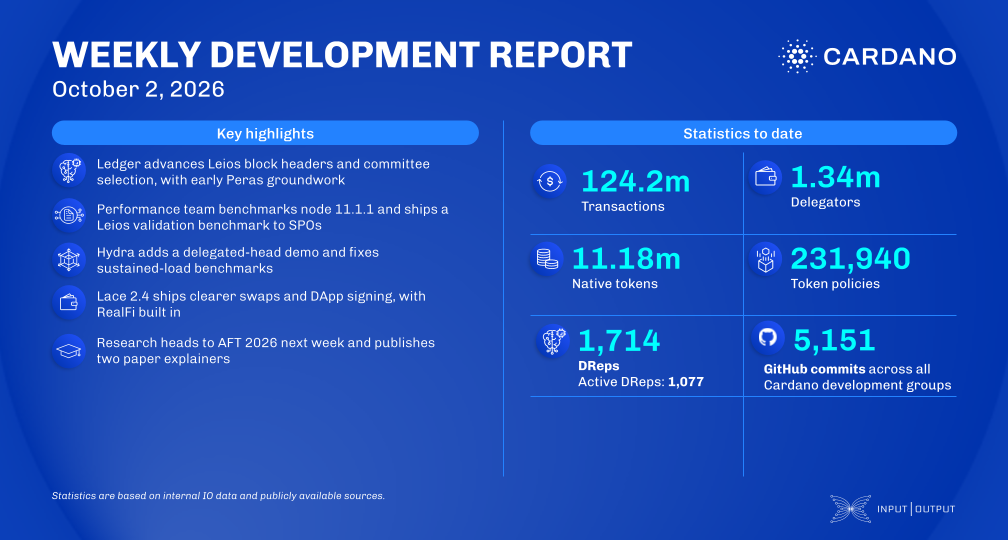
The Leios committee is selected at the epoch boundary, Plutus scripts can now see the sub-transaction index, and Dijkstra gains protocol parameters for reference-input costs. Node 11.1.1 benchmarks keep the CPU gains of 11.1.0, the Leios transaction benchmark runs standalone for SPOs without nix or a Haskell toolchain, and Hydra reports BacklogFull only when its backlog would take too long to clear.

weekly development report banner

Leios prototype database splits into rollback and settled files

Input Output Global
Global IO holding

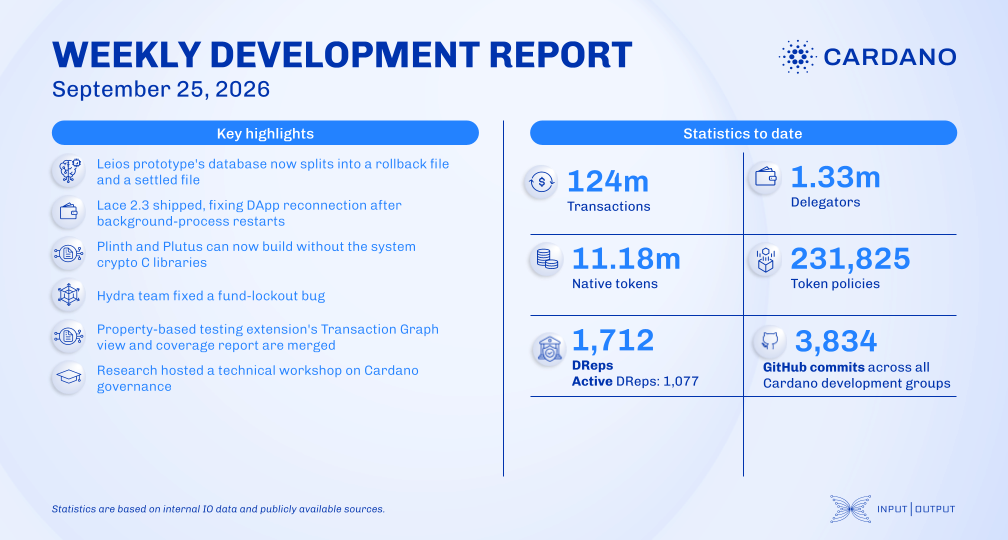
Certified Endorser Blocks move from the rollback file to the settled one in the background, so each database file can live on its own disk, and garbage collection marks rows before deleting them in batches instead of blocking the node. Lace 2.3 shipped reworked staking and DRep browsers with broader hardware wallet support, Hydra fixed a Mesh SDK deposit lockout and replaced 13 slow end-to-end tests with 30 unit tests, and Plutus closed out its September milestones.

weekly development report banner

Dijkstra batch validation runs Plutus scripts as Hydra closes fanout wedge

Input Output Global
Global IO holding

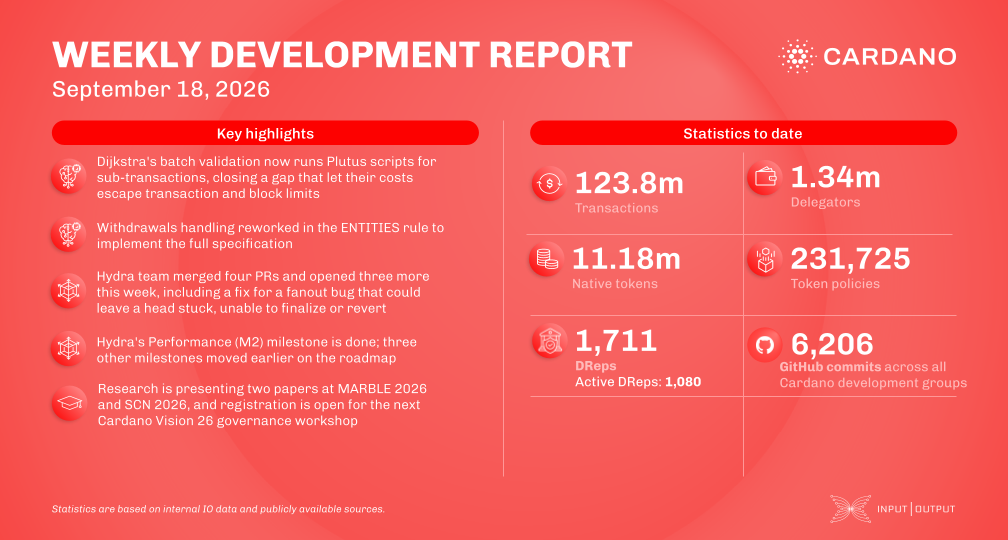
Dijkstra batch validation was implemented so Plutus scripts for sub-transactions now run and their execution budgets count toward block and fee limits, closing a gap where validators and minting policies went unchecked. Withdrawals handling was reworked in the ENTITIES rule, TxInfo translation for protocol version 4 was implemented, and Leios protocol parameters landed in the Dijkstra era. Hydra closed a fanout wedge that could leave a head stuck after a partial withdrawal, stabilized broadcast connections under heavy load, and completed the Performance milestone.

weekly development report banner

Plutus moves to Midgard Labs

Input Output Global
Global IO holding

Plutus moves from IO Labs to Midgard Labs, joining Se7en Labs, Teragone, ICAN Group, and BlockPQR as specialist teams maintaining core Cardano functions. Midgard Labs already audits and writes Plutus smart contracts, contributes to the Plutarch and Aiken ecosystems, and its CEO helped bring Plutus tooling into the Plutus Pioneer Program. The transition is coordinated openly through Intersect.

plutus midgard labs banner

Leios improves downloads and caching as Plutus merges casing on Data

Input Output Global
Global IO holding

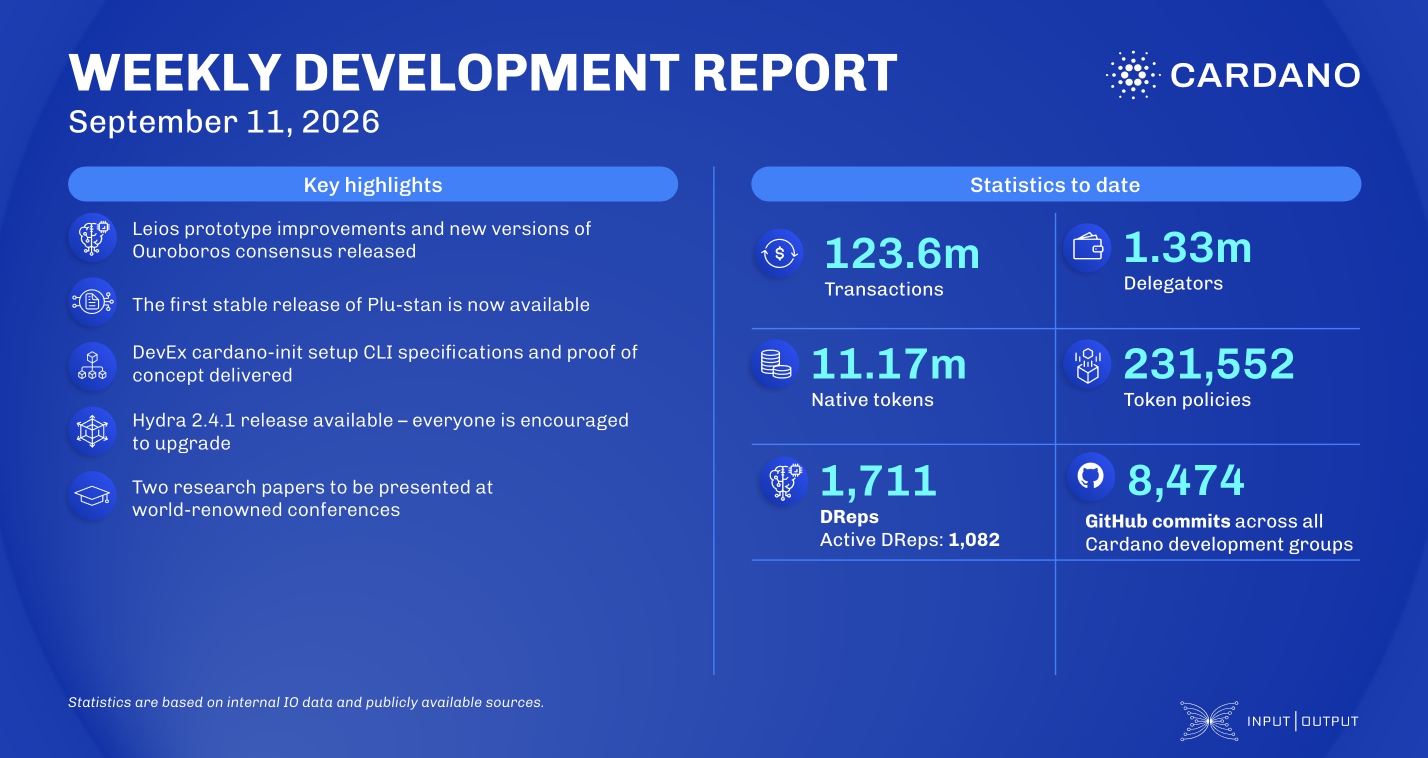
The Leios download logic was rewritten to bound time and memory, a transaction cache was added, unwanted node disconnects were fixed, and mempool ledger reads were capped, while ledger state garbage collection was threaded. Plutus merged casing on Data, advanced the keepPolicies and dropPolicies built-ins for the future Dijkstra era, and released Plu-tan 1.0, the static analyzer for Plutus scripts. Hydra shipped 2.4.1, a security release removing an optimized transaction-validation path that could let a malicious participant get invalid transactions into confirmed snapshots.

weekly development report banner

Node v11.1.0 benchmarks and Hydra formalized in Agda

Input Output Global
Global IO holding

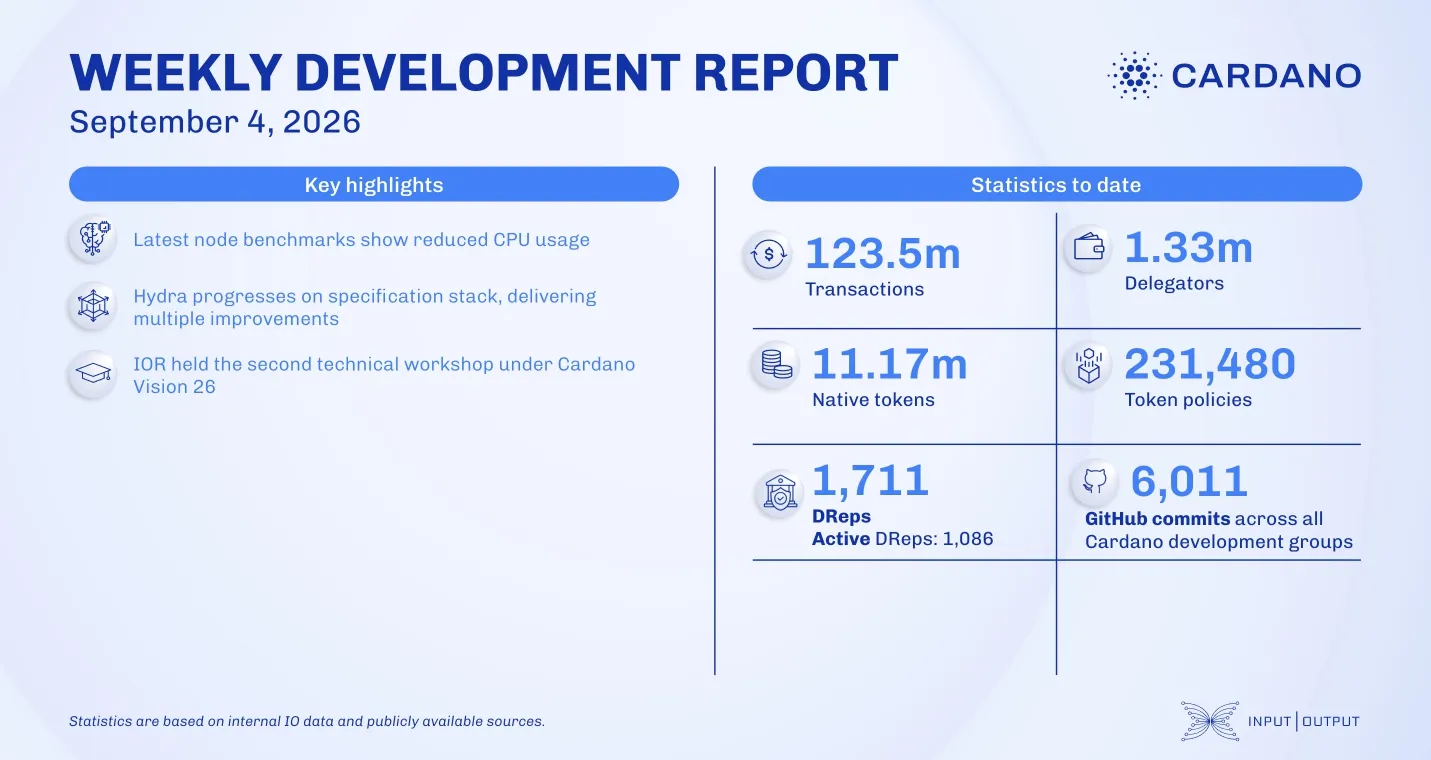
Benchmarks of Cardano node v.11.1.0 showed reduced CPU usage alongside a memory increase that is being addressed in the v.11.1.1 patch release. The Hydra team moved its specification to Typst, formalized it in Agda, and published native Linux ARM64 node images alongside AMD64, with faster Blockfrost query caching. The research team held its second Cardano Vision 26 workshop, covering data availability requirements and specifications.

Weekly Development Report

Lace adds Keystone support and Plutus releases v1.68.0.0

Input Output Global
Global IO holding

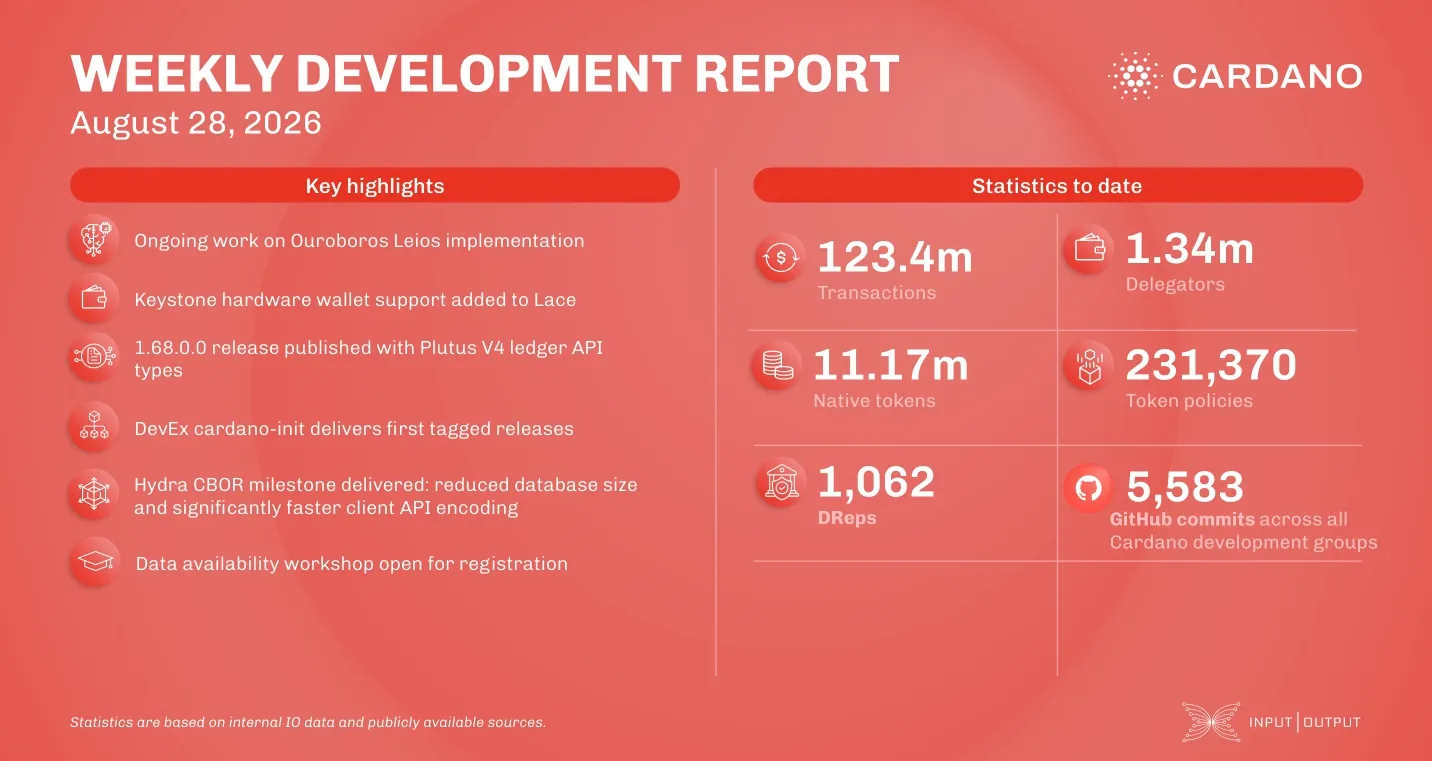
Lace added support for the Keystone hardware wallet in both the browser extension and the mobile app, bringing the wallet to four supported devices. The Plutus team published release 1.68.0.0 with Plutus V4 ledger API types, cardano-init reached its first tagged releases, and Hydra moved persisted event payloads to CBOR, shrinking a three-node benchmark database by more than half. Plinth also gained a one-command install script.

Weekly Development Report

Java developers already know how to build on Cardano

Cardano Foundation
Not-for-profit organization

Java developers can build on Cardano with the tools they already use, according to a Cardano Foundation walkthrough of the open-source BloxBean stack. Adding a dependency, writing a test and calling a REST endpoint cover most of what is needed, while the extended UTXO model and validator scripts can be learned gradually alongside. The post also previews three experimental Java projects now in development.

Java developers already know how to build on Cardano