メインコンテンツまでスキップ

Cardano News

Explore the stories below for curated news, stories, and inspiration from within the Cardano ecosystem.

Studying how blockchains fit sustainability compliance reporting

Cardano Foundation
Not-for-profit organization

The Cardano Foundation, CEMS and SGH Warsaw School of Economics studied how well public blockchains fit sustainability compliance reporting. The three-month student project produced an analysis of global sustainability regulation, a scorecard for assessing networks against reporting requirements, and a scoped pilot business case showing measurable return on investment. The team also mapped how much regulatory pressure companies face in each region.

Studying how blockchains fit sustainability compliance reporting

MusashiNet testnet Earth phase closes after 41 days

Input Output Global
Global IO holding

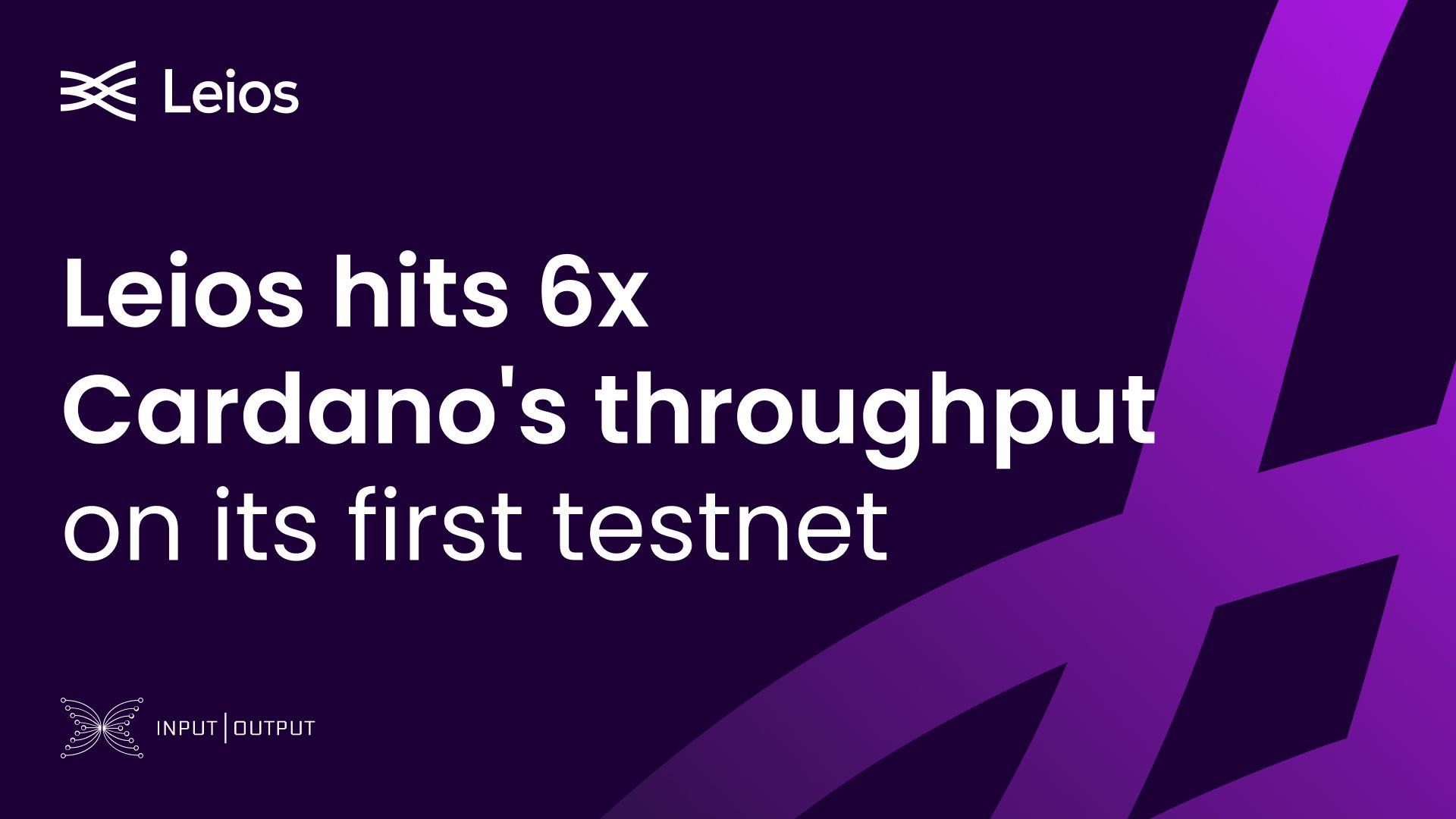
The Leios team completed the Earth phase of MusashiNet, the public testnet, after 41 days that produced over 127,000 blocks and grew participation from three pools to 63. Under synthetic load the network peaked at roughly six times the throughput Praos reaches on mainnet today. The ledger team extended pool distribution with BLS keys, and the Water phase is now open on a fresh chain.

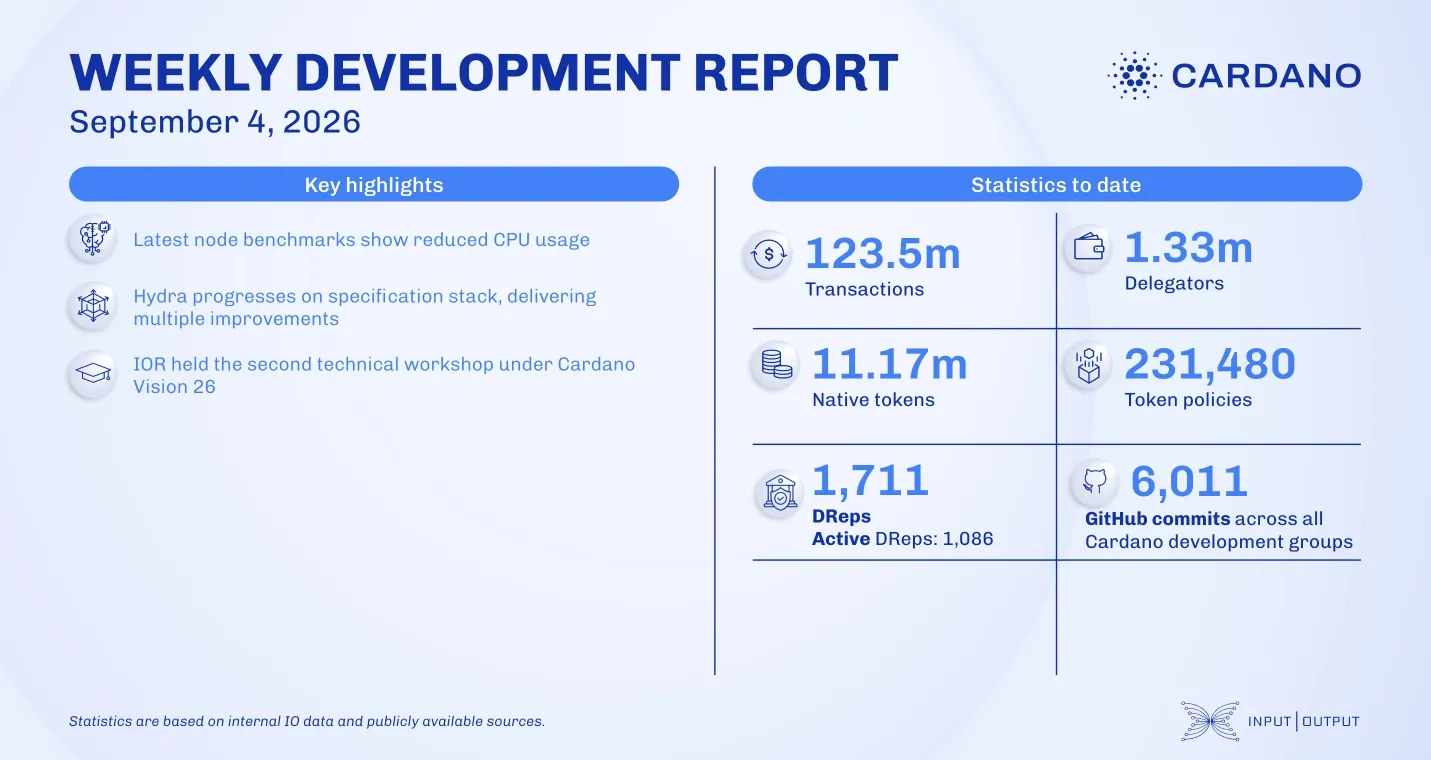
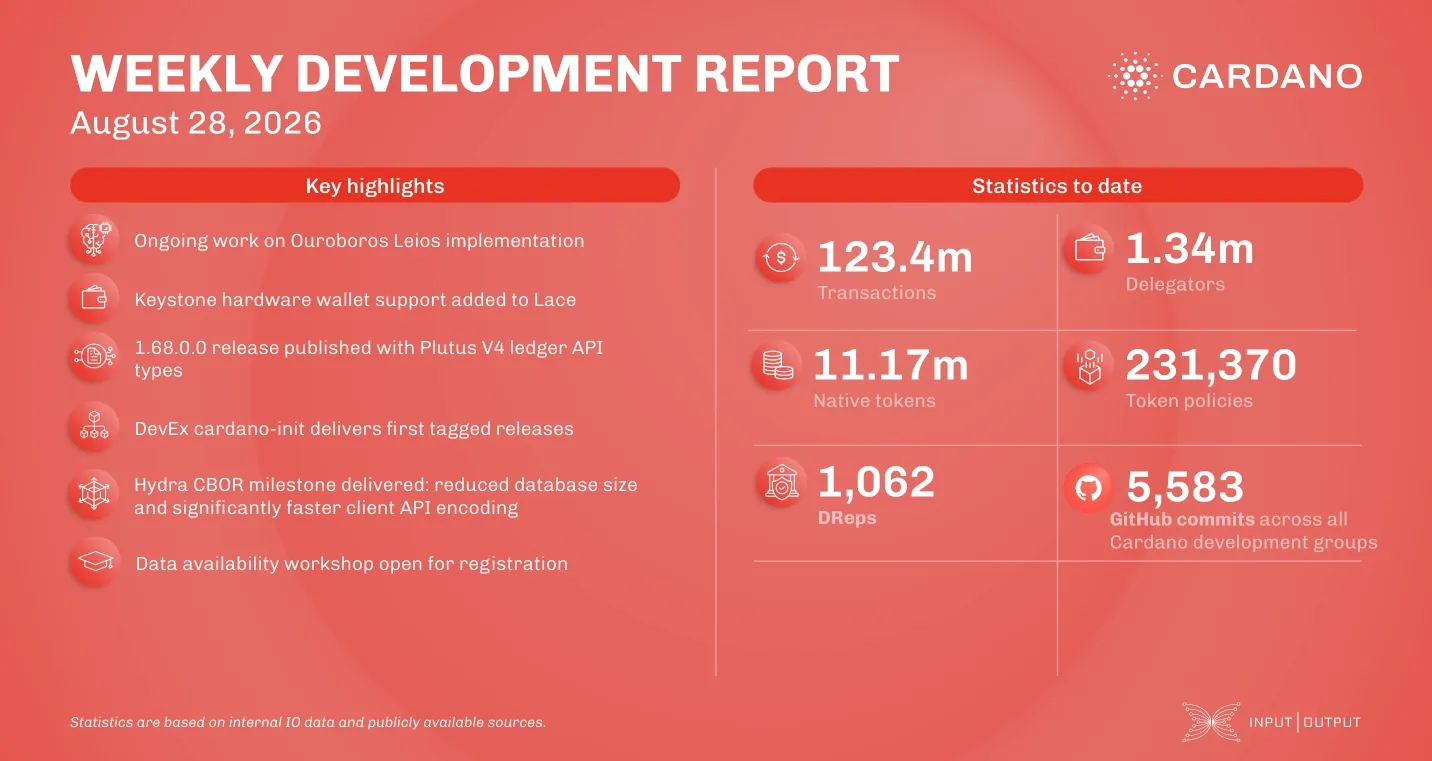
Weekly Development Report

TOKEN2049 applications open and two votes are due before September 1

Cardano Community
Individuals interested in or actively supporting the Cardano blockchain

The Cardano Foundation is bringing its largest presence yet to TOKEN2049 in Singapore, with applications open for 20 ecosystem projects to join its booth. Two on-chain votes needed action from DReps and stake pool operators before September 1, among them the 2026 Constitutional Committee update. A new Project Catalyst pilot awards grants of up to 200,000 ada based on real-world usage.

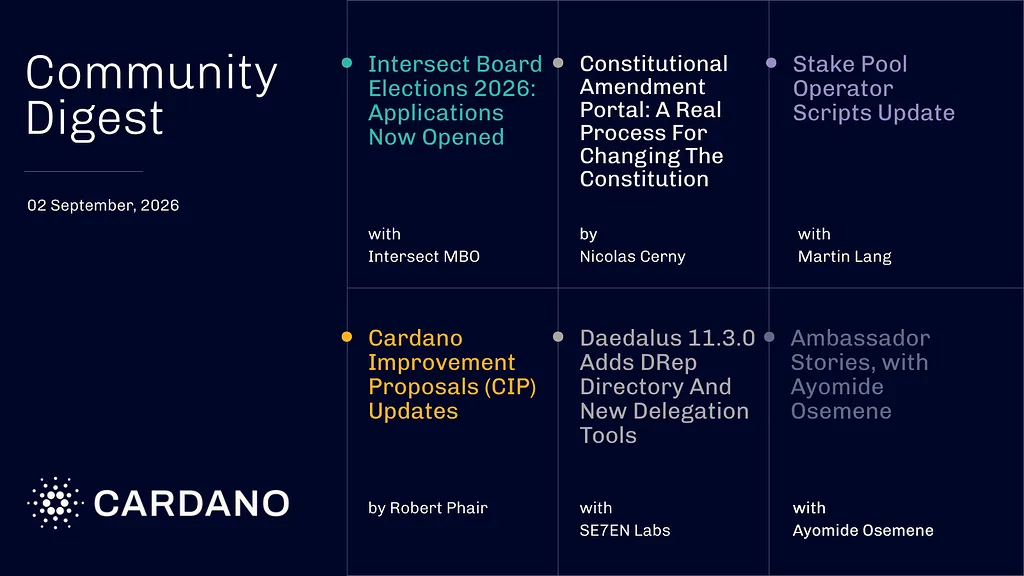
Community Digest

Consensus enables the Dijkstra hard fork and Plutus opens CIP-0194

Input Output Global
Global IO holding

The consensus team released prototype-2026w32, with the node now announcing endorser blocks to peers as a first step toward announcement-based diffusion. Ouroboros-consensus 4.0.0.0 and 4.1 enabled the node to hard fork into the Dijkstra era. The Plutus team opened CIP-0194, CIP-0195 and a new problem statement for community review, and Hydra began rejecting deposits too large to ever be claimed.

Weekly Development Report

The Constitutional Amendment Portal: giving Cardano's Constitution a way to grow

Intersect
Member based organization

The Constitutional Amendment Portal is live for alpha testing at cap.intersectmbo.org, giving the community a structured home for proposing and refining changes to the Cardano Constitution. Users can highlight a precise passage of the Constitution, submit a Constitutional Amendment Proposal or raise an issue, and follow each proposal through its lifecycle. Wallet connection uses a stake address as identity, with no account, email, or password required.

Constitutional Amendment Portal

Hydra 2.3.0 and Dijkstra nested transactions advance

Input Output Global
Global IO holding

The performance and tracing team completed Van Rossem hard fork benchmarks, while the ledger team advanced Dijkstra nested transactions and implemented CIP-50 pledge-leverage-based staking rewards. Hydra released 2.3.0 with a significant snapshot-processing speedup, YAML node configuration, and native HD wallet key support. The developer experience team completed its Community Alignment deliverable with a live ecosystem map, and IO research opened the Cardano Vision '26 Mid-Year report for community feedback.

Weekly Development Report

Cardano and Injective connect via IBC and the CC election concludes

Cardano Community
Individuals interested in or actively supporting the Cardano blockchain

Cardano and Injective are connected via the IBC protocol on testnet, Cardano's first live on-chain IBC rail, enabling native transfers without centralized bridges. The Constitutional Committee election concluded with audited results, confirming Philip DiSarro, Leandros BSP, Marek Mahut, and Cardano Curia as elected candidates. The Musashi Dojo public Leios testnet moved to parameter and load testing ahead of its water phase. The Cardano Foundation announced its Reef Data eG partnership, joined the Energy Tokenization Sandbox, and launched a Governance Applied Academy course, while CIP-0186 on mobile wallet UX completed.

Community Digest

Lowering minPoolCost and completing smart contract capacity increases

Intersect
Member based organization

The Intersect Parameter Committee submitted a parameter update governance action combining a minPoolCost reduction from 170 to 75 ada with the second part of a 25% increase to Plutus memory limits. Ratification requires support from both DReps and stake pool operators. The lower fixed fee gives small pools breathing room as block rewards decline, while the completed memory increase eases contract deployment for developers.

Lowering minPoolCost and completing smart contract capacity increases

New Leios prototype and Lace 2.2 adds Bitcoin hardware wallet support

Input Output Global
Global IO holding

The consensus team released prototype-2026w29, enabling endorser block certification inside the forging loop to raise throughput, and extended the LeiosNotify mini-protocol toward the full block-announcement flow. Lace 2.2 introduced Bitcoin support for Ledger and Trezor hardware wallets, added SeedSigner air-gapped signing, and published the results of an independent security audit. Plutus implemented the multiIndexArray and policies built-ins from CIP-0156 and CIP-0168, gated behind the Dijkstra era, while Mithril completed IVC SNARK benchmarks and prepared the 2630 distribution.

Weekly Development Report

Cardano Foundation and Reef Data eG announce partnership

Cardano Foundation
Not-for-profit organization

The Cardano Foundation partnered with Reef Data eG, a Hamburg-based data cooperative, to record payment flows transparently and auditably on the Cardano blockchain using Reeve, the Foundation's open-source reporting transparency platform. Reef Data developed the application layer, including a user wallet extension and public and auditor dashboards, while the Foundation provided and extended the Reeve Publisher and Data Reader services. The pilot demonstrates how sales, reward distributions, and member payouts can be verified on-chain by cooperative members and independent auditors.

Cardano Foundation and Reef Data eG partnership